

For almost a decade, one molecule has carried the economic argument for fault-tolerant quantum chemistry. The iron–molybdenum cofactor of nitrogenase, FeMoco, is the metal cluster that lets bacteria turn atmospheric nitrogen into ammonia at room temperature. It appears in roadmaps, investor decks and resource-estimate papers as the canonical example of a calculation that classical computers cannot do and quantum computers eventually will.
On November 19, at SC26 in Chicago, the ACM gave its 2026 Gordon Bell Prize to a ten-person team from Chinese institutions for a paper titled "Closing the FeMo-Cofactor 'Quantum-Advantage' Gap with Exascale Supercomputers." The headline number is blunt: the team reports reaching a ground-state energy "consensus" for the standard 76-orbital FeMoco model in a measured 105 minutes on 1,280 nodes of the LineShine supercomputer, about one-fifth of the best published 8.6-hour projection for a fault-tolerant quantum computer on the same problem.
It is tempting to read this as "classical wins, quantum loses." That reading is wrong in both directions. The interesting part is what kind of number each side is reporting.
Why FeMoco became the benchmark
The quantum case was set out in 2017 by Reiher, Wiebe, Svore, Wecker and Troyer in PNAS, using a 54-electron, 54-orbital active space now called FeMoco-54. In 2019, Zhendong Li, Garnet Chan and colleagues argued in the Journal of Chemical Physics that this model did not represent the cofactor's ground state well, and proposed a larger model: 113 electrons in 76 orbitals, CAS(113e, 76o), often called FeMoco-76 or the LLDUC model after its authors' initials.
FeMoco-76 then became the target for every new quantum algorithm. Under the cost model Low et al. later used, the tensor-hypercontraction algorithm of Lee et al. (PRX Quantum, 2021) implies about 12 days of runtime on a surface-code machine. In 2025, Low and colleagues at Google Quantum AI and partner institutions combined a new factorization with spectrum amplification (Phys. Rev. X 15, 041016) and cut that to 4.5 million physical qubits running for 8.6 hours, assuming a 10⁻³ physical error rate, a 1 µs code cycle, distance-27 surface code patches and four CCZ factories. That 8.6-hour figure is the one the Gordon Bell team compares against.
The key point is that "beyond exact diagonalization" was always the real claim. Nobody can store the exact wave function for 76 strongly correlated orbitals. But approximate classical methods never stopped improving, and chemistry only needs an energy to about 1 kcal/mol (roughly 1.6 millihartree), not the exact wave function.
What the Gordon Bell team reported
The paper is by Honghui Shang, Jinlong Yang and colleagues at the University of Science and Technology of China and the Hefei National Laboratory, with Yutong Lu of Sun Yat-sen University and researchers from the Institute of Physics (CAS) and China's National High Performance Computer Engineering Technology Research Center. The public abstract reports:
Sustained 1.456 exaflop/s in double precision on 20,480 LineShine nodes, 58.9% of machine peak, and 5.626 exaflop/s in mixed precision.
A port to a second exascale system, China's New-generation Intelligent Supercomputer (CNIS). USTC's announcement adds that it reached 5.08 exaflop/s in BF16 on 45,000 accelerators there.
A FeMoco-76 ground-state result on 1,280 LineShine nodes with a measured end-to-end wall time of 1.75 hours.
The full paper sits in the SC26 proceedings, and the public abstract does not name the wave-function method. USTC describes the approach as a fusion of conventional supercomputing and AI-style computing. The group's recent arXiv preprints focus on neural-network quantum states and on GPU-accelerated selected configuration interaction with perturbative corrections. So the exact error model behind the word "consensus" is something readers should check in the paper, not assume.
It was not the first classical answer
The Gordon Bell result builds on earlier work. In January 2026, Huanchen Zhai, Garnet Chan and colleagues posted "Classical computational simulation of the FeMo-cofactor model to chemical accuracy and its implications" (arXiv:2601.04621). Their main insight is that the FeMoco-76 ground-state problem is mostly about ranking many competing but individually simple broken-symmetry states. High-order coupled cluster and density-matrix renormalization group (DMRG) calculations, combined with an extrapolation protocol, gave an energy to about chemical accuracy. They also found several spin-isomer candidates that are degenerate to within chemical accuracy.
Zhai et al. converted their cost into an idealized time on the Frontier supercomputer: 46.3 seconds for the DMRG extrapolations, based on counted floating-point operations divided by Frontier's 1.102 exaflop/s. The actual DMRG work consumed about 2.77 million CPU core-hours. A purely variational DMRG run reaching the same accuracy without extrapolation would, by the same metric, take 22.9 hours.
So the classical "gap" for FeMoco-76 was already closed on paper in January. What the Gordon Bell team adds is a measured, end-to-end, machine-scale run that reaches the same kind of answer in under two hours.
Our analysis: a measurement, an idealization and a projection
The three headline numbers in this story are different kinds of evidence. Put side by side, they look like this:
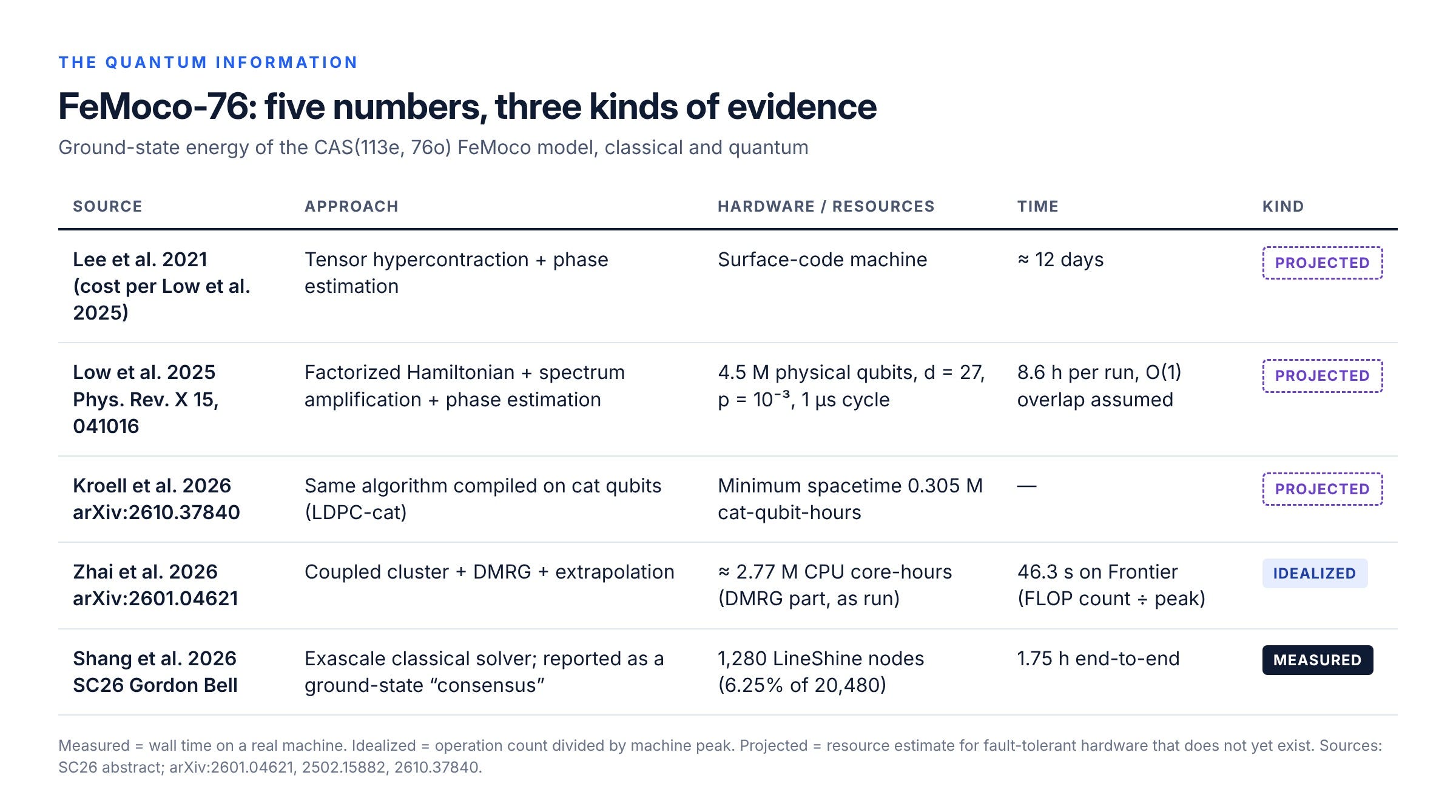
Three things stand out.
First, only one number was measured. The 105 minutes happened on a real machine. The 46.3 seconds is a lower bound from operation counts. The 8.6 hours describes a 4.5-million-qubit fault-tolerant computer that does not exist. Today's quantum processors have at most a few thousand physical qubits, not millions. Comparing 105 minutes with 8.6 hours treats a stopwatch reading and an engineering forecast as the same kind of quantity.
Second, the classical run was small for its machine. We worked from the abstract's own figures. 1.456 exaflop/s at 58.9% of peak implies a double-precision peak of about 2.47 exaflop/s, or about 121 teraflop/s per node. The FeMoco run used 1,280 of 20,480 nodes, which is 6.25% of the machine, for 2,240 node-hours. Even if every one of those nodes had run at peak the whole time, the calculation could not have exceeded about 9.7 × 10²⁰ double-precision operations. That is a very large calculation, but it is a routine allocation on a leadership-class system, not a hero run.
Third, the 8.6 hours leaves out a term. Quantum phase estimation returns the ground-state energy only with probability equal to the squared overlap between the prepared input state and the ground state. Low et al. assumed an overlap of order one. Zhai et al. computed an overlap of 0.4468 between a filtered broken-symmetry determinant and their DMRG state, and they note that it should be read as overlap with the manifold of states within 1 kcal/mol of the ground state. The paper's wording does not settle whether 0.4468 is an amplitude or a probability, so we computed both cases:
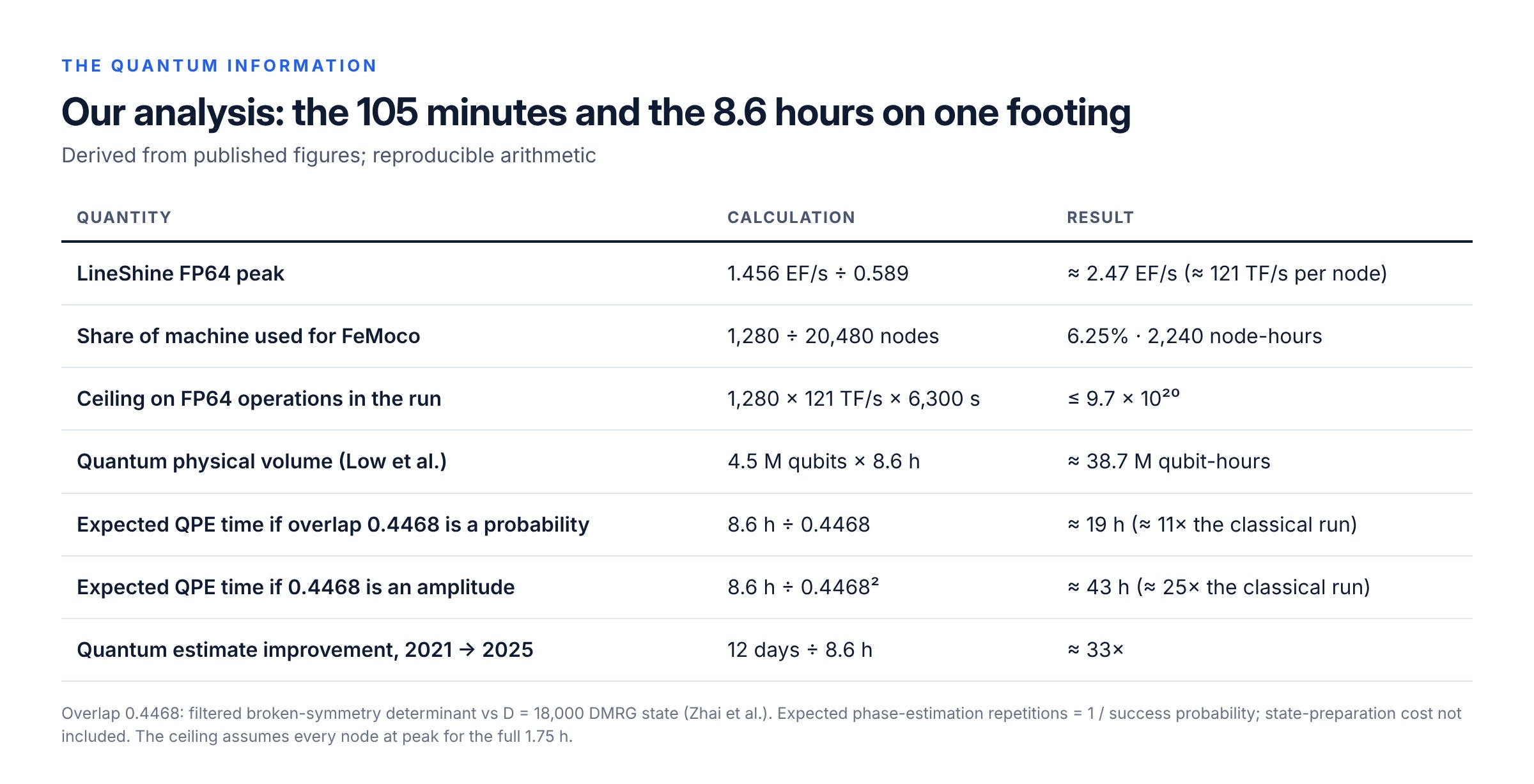
If 0.4468 is the per-run success probability, the expected quantum cost is about 2.2 runs, or roughly 19 hours, about 11 times the classical wall time. If it is an amplitude, the success probability is about 0.20, giving about five runs and roughly 43 hours, about 25 times the classical wall time. Either way, state preparation adds more cost on top. In wall-clock terms, the honest comparison is not "5× slower." It is "one to two orders of magnitude slower, on hardware that does not exist yet."
That does not make the quantum algorithms look bad. Their projected runtime for this exact problem fell from about 12 days (2021) to 8.6 hours (2025), a 33× improvement in four years. Low et al. note that magic-state cultivation could make even the 8.6 hours a "substantial overestimate." Alice & Bob's October 2026 compilation of the same algorithm on cat qubits (the company's roadmap was the subject of yesterday's edition) reports a minimum spacetime volume of 0.305 million cat-qubit-hours for FeMoco-76. Both sides of this race are moving, and Zhai et al. call their comparison "a snapshot in time."
What classical still lacks: a certificate
The strongest argument left for quantum computing on this molecule is not speed. It is error control.
Kroell et al. state plainly that the coupled-cluster and DMRG estimates "come without a formal error bound." A variational DMRG energy at finite bond dimension is an upper bound, but the chemically accurate number comes from extrapolation, which is a model of how the error behaves, not a proof. Agreement between independent methods, which is presumably what "consensus" means in the Gordon Bell abstract, is strong evidence. It is still not a certificate.
Quantum phase estimation, given enough overlap and a correct Hamiltonian, returns an eigenvalue with controlled statistical error. That is a qualitatively different guarantee, and it matters most exactly where Zhai et al. found the chemistry to be hardest: several spin isomers lie within 1 kcal/mol of each other. Ranking them correctly needs relative energies more accurate than the spacing between them. A heuristic that is accurate to about 1 kcal/mol in absolute energy cannot certify that ranking.
There is a classical route to a certificate as well. Methods that bound the energy from below, such as variational two-electron reduced-density-matrix theory, now run on the 76-orbital model: DePrince and Rubin report about 25 hours on one H100 GPU (arXiv:2610.30278). A lower bound from that side and a variational upper bound from DMRG would bracket the true energy. We have not seen a published bracket for FeMoco-76 tight enough to reach chemical accuracy. If one appears, the last technical argument for FeMoco-76 as a quantum-advantage target disappears.
What this means for quantum chemistry roadmaps
The resource-estimation community has already adjusted. Kroell et al. write that they "do not treat FeMoco as a demonstration of quantum advantage but as a benchmark": a fully specified Hamiltonian that lets algorithms, codes and compilers be compared like for like. That is the right role for it. The 2023 Nature Communications analysis by Lee, Chan and colleagues reached a related conclusion more broadly: evidence for exponential quantum advantage in ground-state chemistry "has yet to be found."
For anyone reading a quantum chemistry roadmap, the practical lessons are:
Treat FeMoco-76 resource estimates as compiler benchmarks, not value cases. A projected runtime against a problem that classical computers already handle is not evidence of commercial advantage.
Ask what the classical baseline is, and whether it was measured or idealized. A quantum estimate published without a classical baseline is half a comparison.
Look for targets where the "ranking simple states" insight fails. These include larger and more realistic active spaces, reaction intermediates, excited states and dynamics. Zhai et al. find that many features of the FeMoco energy landscape persist in more detailed models, which points toward harder but more meaningful benchmarks.
What to watch
The next milestone is not another speed record on FeMoco-76. It is an error bar. Watch for three things: the full SC26 paper's description of how "consensus" was established and how its energies compare with Zhai et al.'s spin-isomer ranking; a classical upper-and-lower-bound bracket for the 76-orbital model; and the first fault-tolerant resource estimate that names a successor benchmark and publishes a measured classical baseline next to it. Whoever moves the goalposts in a well-defined way will set the terms of the next decade of quantum chemistry claims.
Sources
Shang H. et al., "Closing the FeMo-Cofactor 'Quantum-Advantage' Gap with Exascale Supercomputers," SC26 (Gordon Bell Prize): SC26 abstract · IEEE CSDL
ACM press release, 2026 Gordon Bell Prize (Nov 19, 2026): acm.org · The Quantum Insider repost
USTC news release (Nov 21, 2026, in Chinese): news.ustc.edu.cn
Zhai H. et al., "Classical computational simulation of the FeMo-cofactor model to chemical accuracy and its implications," arXiv:2601.04621
Low G. H. et al., "Fast quantum simulation of electronic structure by spectrum amplification," Phys. Rev. X 15, 041016 (2025), arXiv:2502.15882
Kroell L. et al., "Ground-state energy estimation compiled on cat qubits: 6 808 qubits for FeMoco-54 in 23.6 hours," arXiv:2610.37840
Low G. H. et al., "A Denser Planar Surface Code," arXiv:2605.30455
Lee J. et al., "Even more efficient quantum computations of chemistry through tensor hypercontraction," PRX Quantum 2, 030305 (2021), arXiv:2011.03494
Li Z. et al., "The electronic complexity of the ground-state of the FeMo cofactor of nitrogenase as relevant to quantum simulations," J. Chem. Phys. 150, 024302 (2019), arXiv:1809.10307
Reiher M. et al., "Elucidating reaction mechanisms on quantum computers," PNAS 114, 7555 (2017), arXiv:1605.03590
Lee S. et al., "Is there evidence for exponential quantum advantage in quantum chemistry?" Nat. Commun. 14, 1952 (2023), arXiv:2208.02199
DePrince A. E. III and Rubin N. C., "Automated generation and execution of large-scale semidefinite programs for variational two-electron reduced density matrix theory," arXiv:2610.30278