

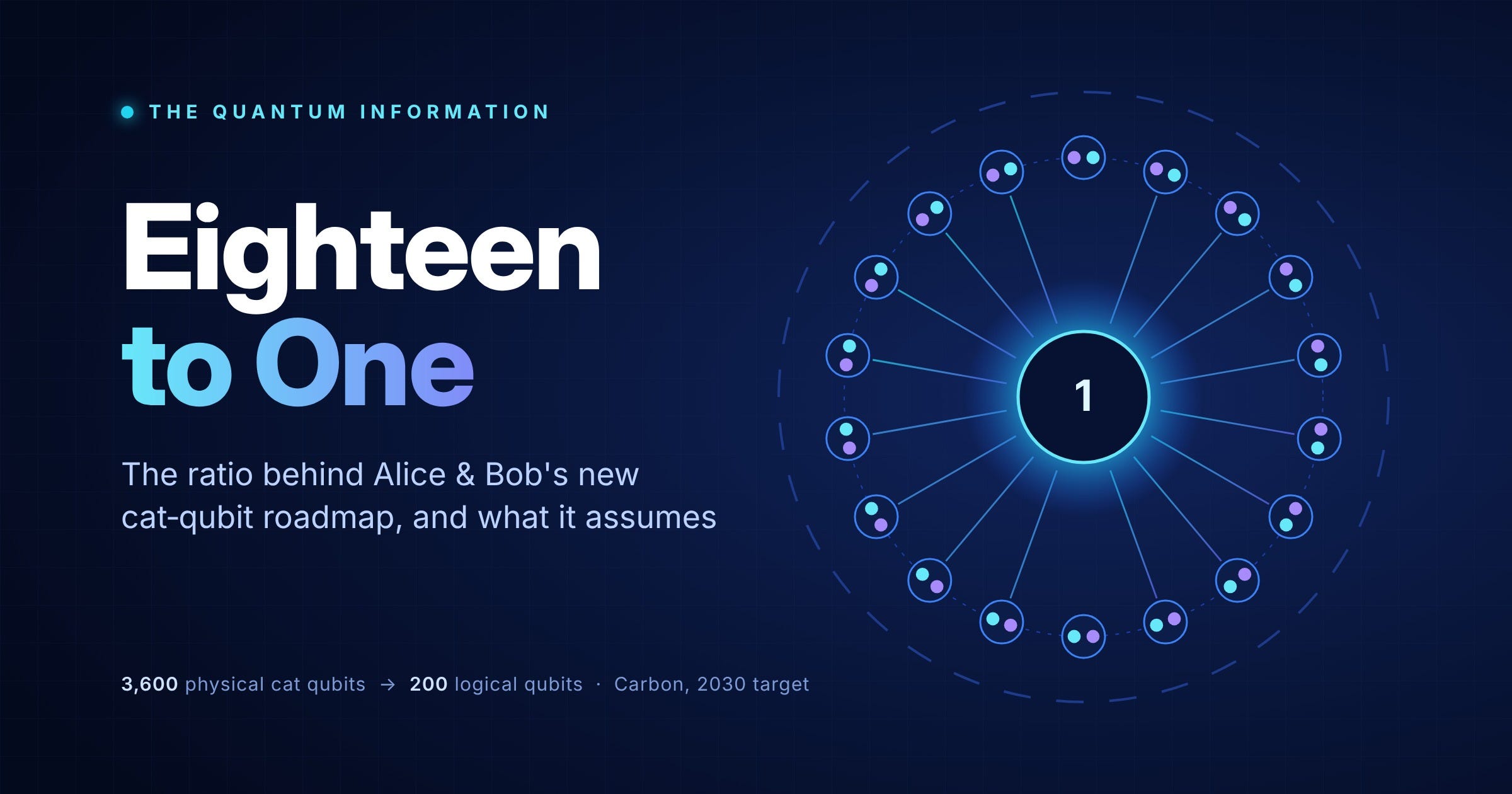
On November 18, Alice & Bob, the Paris- and Boston-based maker of superconducting cat qubits, published a roadmap that doubles its 2030 goal. Its first roadmap, released in December 2024, ended with Graphene, a machine of 100 logical qubits. The new one targets 200 logical qubits in 2030 on a system called Carbon, built from 3,600 physical cat qubits, and then runs to 2034, ending with Neon: 2,048 logical qubits that the company describes as sized for RSA-2048.
Most coverage stopped at the headline numbers. The more useful figure is the one CTO Raphaël Lescanne built his own explanation around: how many physical qubits it takes to make one logical qubit. For Carbon that is 3,600 ÷ 200 = 18. A surface code reaching the same logical error rate under standard assumptions needs about 240. If cat qubits deliver 18-to-1 at scale, they change the size, cost and power budget of a fault-tolerant machine. The real questions are what has to be true for that ratio to hold, and how much of it has been shown.
What the roadmap actually specifies
The roadmap graphic on Alice & Bob's website is far more specific than the press release. For each system it lists the number of modules, physical qubits, the error-correcting code, a "clock speed," a target logical error rate (LER) and a budget of logical operations. We transcribed it and added two derived columns.
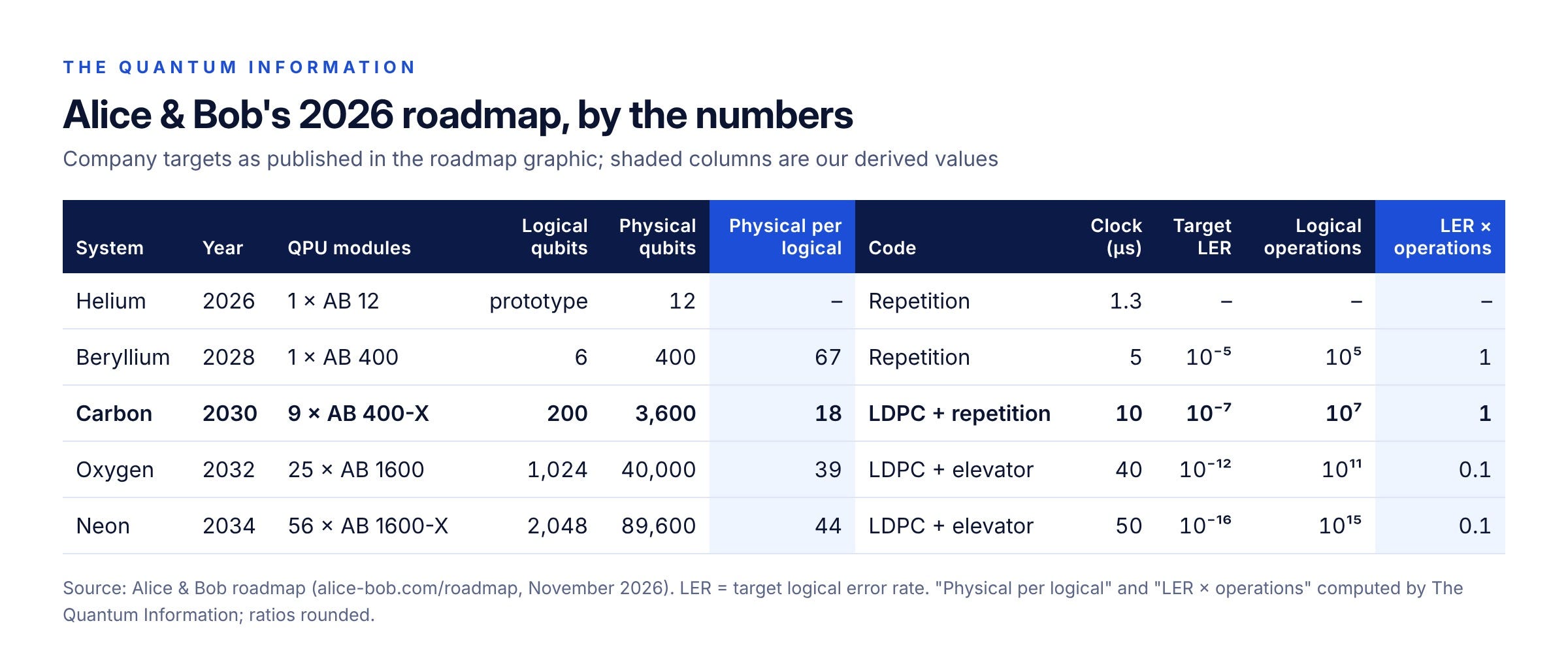
Three things stand out.
First, the ratio is not monotonic. It falls from about 67 on Beryllium (2028), a single 400-qubit chip running repetition codes, to 18 on Carbon, where LDPC codes on a five-neighbor 2D layout take over. Then it rises again, to 39 on Oxygen and about 44 on Neon. Lescanne's accompanying blog post explains why: at Oxygen's scale and run length "even rare bit-flips start to matter," so a second layer of error correction, which the company calls elevator codes, is added to catch them.
Second, Carbon is modular from day one: nine cryostats, each holding a 400-qubit processor (3,600 ÷ 9 = 400), linked by superconducting cables that share Bell pairs between chips. Oxygen and Neon move to 1,600-qubit modules, 25 and 56 of them. The company's first quantum-link demonstration is planned for 2028, two years before Carbon needs it.
Third, the logical-operations row is not an independent capability claim. Our analysis: multiply each system's target LER by its operation budget and you get exactly 1 for Beryllium and Carbon and 0.1 for Oxygen and Neon. The operations figure is the error budget restated: the number of logical operations you can run before expecting about one failure (or, for the later machines, a one-in-ten chance of one). That is a sensible way to define a usable circuit size, but "10 million operations" on Carbon and "100 billion" on Oxygen add no information beyond the LER targets themselves.
Why cat qubits can afford 18-to-1
Qubits suffer two kinds of error: bit flips, which swap 0 and 1, and phase flips, which flip the sign of a superposition. A surface code has to correct both, which is why it needs a two-dimensional patch of roughly 2d² physical qubits for code distance d.
A cat qubit stores its 0 and 1 in two coherent states of a microwave resonator, held in place by engineered two-photon dissipation. A bit flip requires the field to jump between two well-separated states, and that rate falls exponentially as the photon number grows. Phase flips get somewhat worse with more photons. The trade is deliberate: make one error nearly vanish, then correct only the other with what is essentially a classical code.
That second code is where the ratio comes from. A repetition code against phase flips needs about 2d qubits per logical qubit (d data qubits plus d − 1 ancillas) instead of 2d². LDPC-cat codes, which Alice & Bob researchers proposed in 2024 and published in Nature Communications in 2025, go further by packing many logical qubits into one classical LDPC code. In that paper, 758 cat qubits encode 100 logical qubits with a logical error probability of at most 10⁻⁸ per cycle and per logical qubit, assuming a physical phase-flip probability of about 0.1%. That is 7.6 physical qubits per logical qubit.
Our analysis: Carbon's 18-to-1 is about 2.4 times more conservative than that idealized layout, a plausible margin for routing, magic-state factories, inter-module links and dead qubits. The roadmap's headline ratio is not the most aggressive number the company could have quoted.
How big the gap to the surface code really is
To make the comparison concrete, we asked how large a surface-code patch would need to be to reach each roadmap system's target LER. We used the common heuristic ε_L ≈ 0.1 · (p/p_th)^((d+1)/2), with physical error rates ten times below threshold, which corresponds roughly to the 0.1% gate errors assumed in Craig Gidney's 2025 RSA estimate. The scaling follows Fowler and colleagues' standard surface-code analysis; using a smaller prefactor of 0.03 instead of 0.1 gives the same distances.
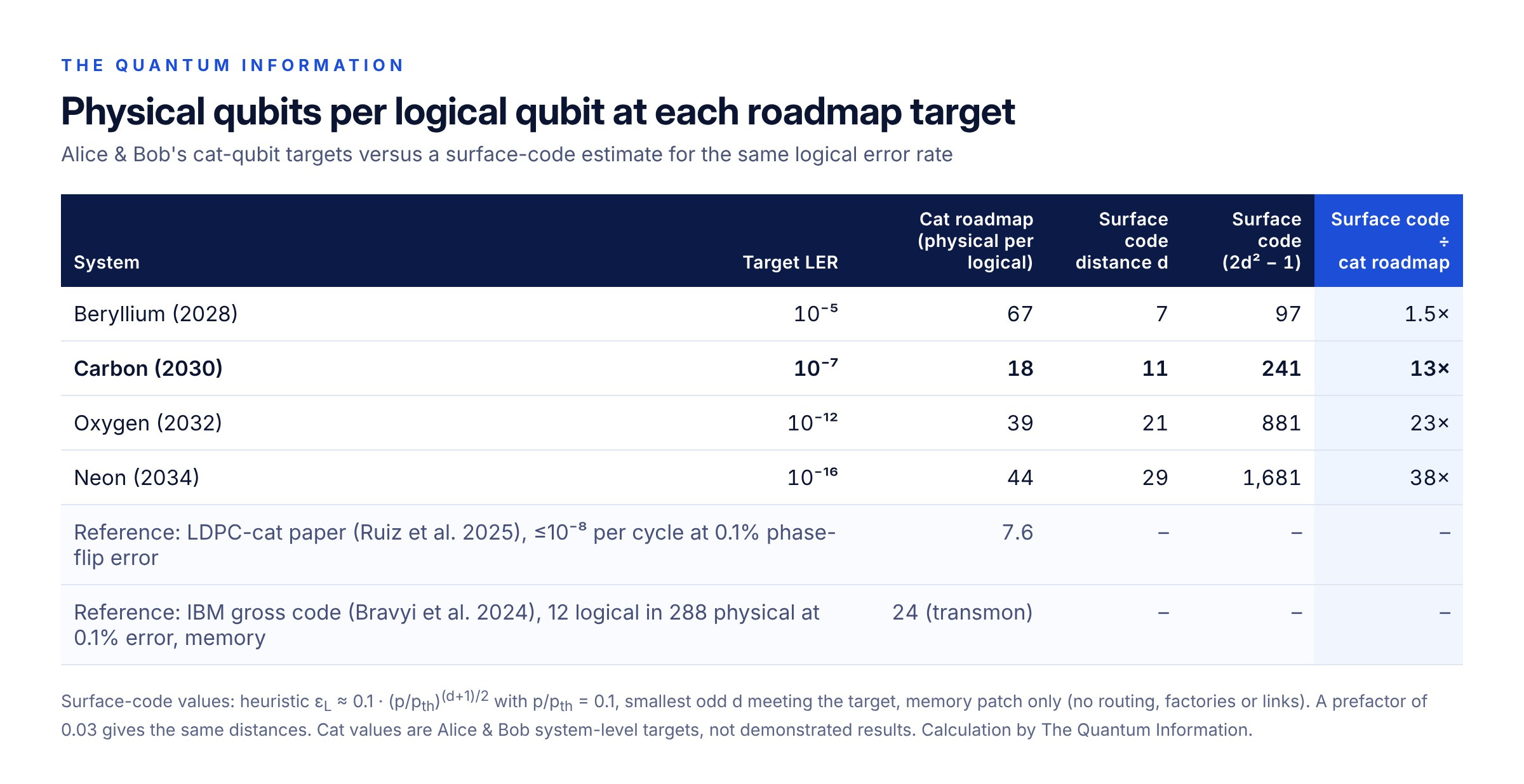
Our analysis: Carbon's 10⁻⁷ needs distance 11, or 241 qubits per logical qubit: a 13-fold gap to Alice & Bob's 18. Oxygen's 10⁻¹² needs distance 21 (881 qubits, 23-fold) and Neon's 10⁻¹⁶ distance 29 (1,681 qubits, 38-fold). At Beryllium the advantage nearly disappears (97 versus 67), because a small repetition-code machine carries fixed overheads.
Two caveats keep this honest. The surface-code figures count only memory patches, so they flatter the surface code relative to a full-system count like Alice & Bob's. On the other hand, the surface code is no longer the main competitor. IBM's bivariate-bicycle "gross" code stores 12 logical qubits in 288 physical qubits, 24 per logical qubit, at a 0.1% physical error rate, and IBM's Starling system targets 200 logical qubits running 100 million operations by 2029. On paper, Carbon offers the same logical-qubit count a year later with a ten-times-smaller operation budget. Against the surface code the cat-qubit advantage is an order of magnitude; against qLDPC transmon designs it shrinks to small factors, and every number on both sides is still a projection.
The RSA arithmetic, adjusted for real bit flips
Neon's "sized for RSA-2048" label rests on an October 2026 preprint by Axel Pappalardo, Dahmun Goudarzi, Élie Gouzien and colleagues (IACR ePrint 2026/2665). It compiles Shor's algorithm all the way down to cat-qubit chip layouts and schedules, and headlines 22,593 cat qubits and 3.14 days for RSA-2048. The company's press release calls that about 40 times fewer physical qubits than Gidney's estimate of under a million.
The assumptions matter: a 1 µs error-correction cycle, a 10 µs reaction time, circuit-level phase-flip noise p_Z = 5 × 10⁻⁴ and no bit flips at all. The authors note that "no bit flips" corresponds to a bit-flip time of about 100 years.
Our analysis: with 22,593 qubits running for 3.14 days, a 100-year bit-flip time means about two bit flips in the entire computation, which is why they can be neglected. At one hour per qubit, the expected count is about 1.7 million. Those have to be corrected, and the paper does so with an extra distance-3 bit-flip code layer that raises the cost to about 45,000 cat qubits.
Alice & Bob's measured bit-flip times are now in that one-hour regime. A September 2025 lab update reported 41 bit flips in 61 hours on a single cat qubit, an average of 44 minutes, using the same "Galvanic Cat" design as its 12-qubit Helium 2 processor; the company's 2024 Nature paper had reported just over 10 seconds. These are idle bit-flip times, though. Keeping them during entangling gates is a separate milestone that has not yet been reported.
So the realistic comparison is about 45,000 versus "under a million": roughly 22-fold, not 40-fold. Gidney's estimate also assumes 0.1% errors of every kind, while the cat estimate assumes 0.05% errors of only one kind. Neither multiplier is wrong; they answer different hardware questions. The adjustment also explains the roadmap's shape: 45,000 sits just above Oxygen's 40,000 qubits, which is why the RSA label lands on Neon, with 89,600.
The bottleneck is the phase flip
Every number above assumes something Alice & Bob has not yet demonstrated: phase flips well below the error-correction threshold. Its October 2026 summary of Phase 1 of France's PROQCIMA program reports three demonstrators (two 6-qubit chips and one 12-qubit chip), noise-biased CNOT gates, multiple cycles of a distance-3 repetition code, a non-Clifford gate on a cat qubit, and a measured logical error rate "not yet below threshold." Lescanne's post is blunt about it: approaching threshold "is not enough: every milestone after it assumes we get deeply below."
Our analysis: to see what "deeply" means, take the RSA paper's noise target. A phase-flip probability of 5 × 10⁻⁴ per 1 µs cycle requires that idling alone cost no more than that, which corresponds to an effective phase-flip time of at least about 2 ms during operation, before any gate error is counted. The 2024 Nature device reported phase-flip times above 490 ns while tuned for very long bit-flip times. Current Helium chips must be considerably better, since they now run a repetition code near threshold, but their phase-flip figures have not been published. Until they are, 18-to-1 is a design output that depends on a noise level still to be shown.
What to watch
The roadmap is internally coherent: the ratios, error budgets and RSA numbers fit together, and the 2030 ratio is more conservative than the company's own best paper. What it lacks is a demonstrated foundation for its central assumption. Three results would change that:
A below-threshold repetition code on Helium-class hardware: logical phase-flip error that falls as the code grows from distance 3 to 5 and beyond, published with per-cycle numbers.
Bit-flip times of an hour or more measured during bias-preserving CNOT gates, not only at idle.
The 2028 quantum-link demonstration, with Bell-pair rate and fidelity per error-correction cycle, since Carbon's nine-cryostat design depends on it.
If the first arrives in 2027, Carbon's 2030 date starts to look like an engineering schedule. If it slips, 18-to-1 remains what it is today: the most consequential ratio in quantum computing that nobody has yet measured.
Sources
Alice & Bob, press release on the accelerated roadmap (18 November 2026) and the roadmap graphic
Raphaël Lescanne, Alice & Bob's Roadmap: Our Path to Useful Quantum Computing (company blog)
Alice & Bob, PROQCIMA Phase 1 results (20 October 2026)
A. Pappalardo et al., Shor's algorithm compiled on cat qubits: 22 593 qubits for RSA-2048 in 3.14 days, IACR ePrint 2026/2665, and the company announcement (29 October 2026)
D. Ruiz et al., LDPC-cat codes for low-overhead quantum computing in 2D, Nature Communications 16, 1040 (2025)
U. Réglade et al., Quantum control of a cat-qubit with bit-flip times exceeding ten seconds, Nature 629, 778 (2024)
Alice & Bob, Just Out of the Lab: A Cat Qubit That Jumps Every Hour, and Quantum Computing Report's coverage of the multi-hour bit-flip results (2 November 2026)
C. Gidney, How to factor 2048 bit RSA integers with less than a million noisy qubits (2025)
S. Bravyi et al., High-threshold and low-overhead fault-tolerant quantum memory, Nature 627, 778 (2024)
IBM, Starling announcement (10 June 2025)
A. G. Fowler et al., Surface codes: Towards practical large-scale quantum computation, Phys. Rev. A 86, 032324 (2012)