

AI disclosure: This story was researched and written with an AI writing program (Claude, by Anthropic). Figures and claims were checked against the primary sources linked at the end.
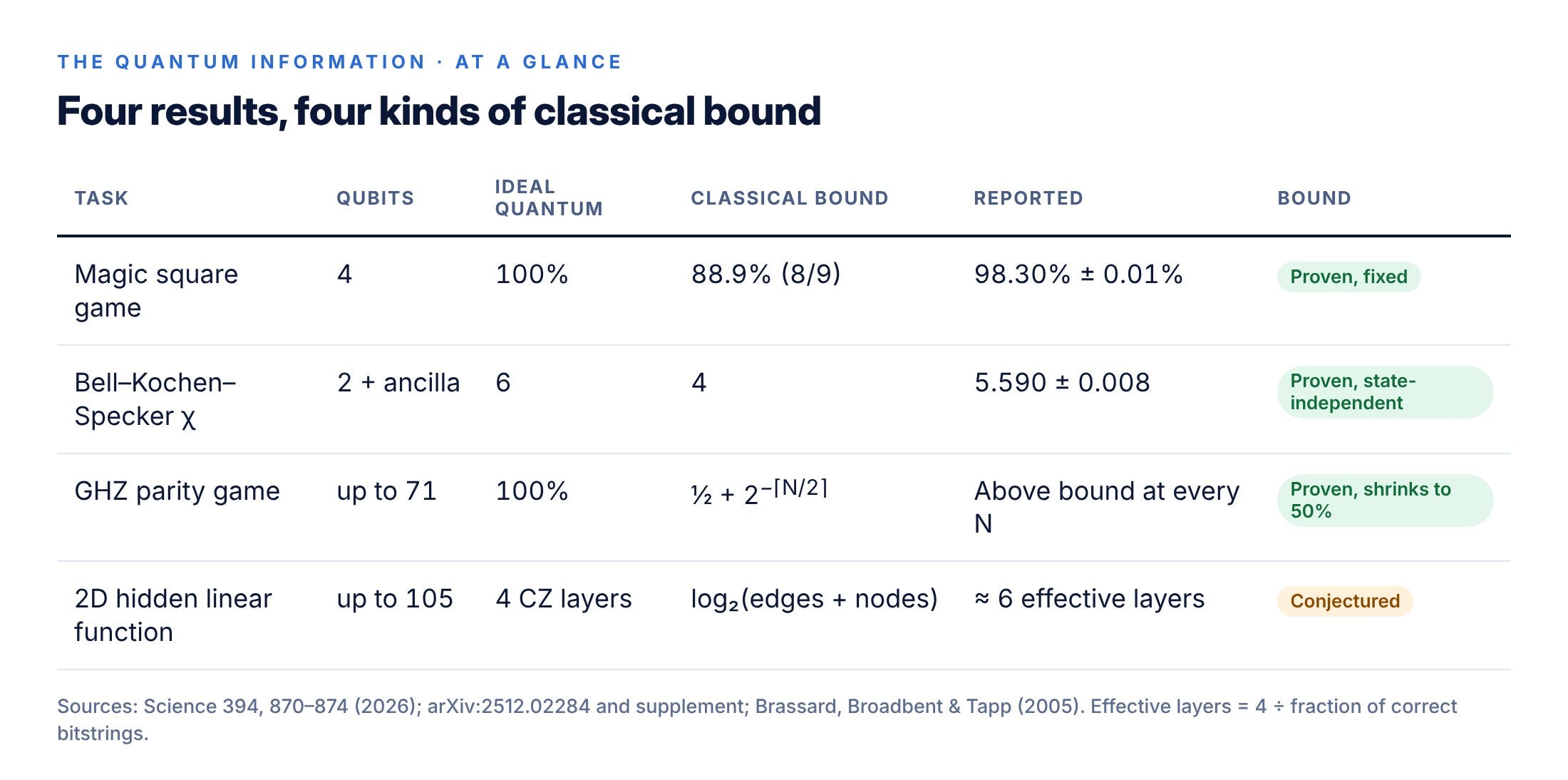
Google Quantum AI's new paper in Science comes with three numbers that travel well. Its qubits won the Mermin–Peres "magic square" game 98.3% of the time against a classical ceiling of 88.9%. They beat the classical limit of a multiplayer parity game with 71 players. And they solved a shallow-circuit problem on grids of up to 105 qubits faster, in a specific sense, than a conjectured classical bound allows.
It is tempting to read those numbers as a ladder, with 105 qubits the most impressive rung. That reading is backwards. The bar each experiment has to clear is set by a different kind of classical bound, and the bounds behave very differently as the system grows. Once you put them next to each other, the four-qubit game turns out to be the most demanding test in the paper, the 71-player result is a statement about something more modest than it sounds, and the 105-qubit result depends on a bound the authors propose rather than prove.
None of this makes the work less interesting. It makes it more precise about what it actually measures.
What is being tested
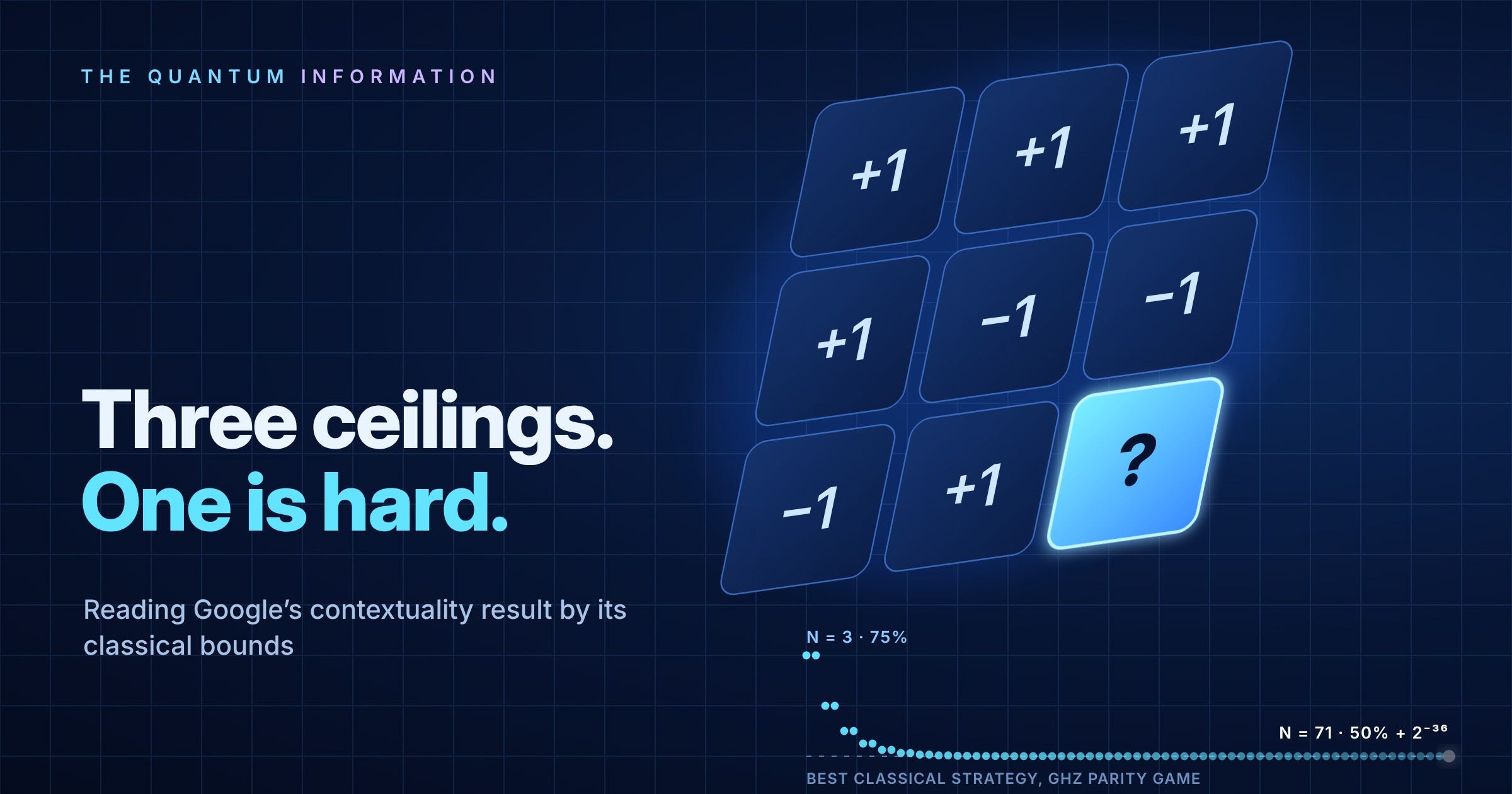
Contextuality is the property that the outcome of a quantum measurement cannot be treated as a pre-existing value. What you get depends on which other compatible measurements are made alongside it. The magic square makes this concrete. Fill a 3×3 grid with ±1 so that every row multiplies to +1 and every column to −1. You cannot: the row rule forces an even number of −1s in the grid, the column rule an odd number.
Turn that into a game. Alice is handed a row, Bob a column, and they win if they put the same value in the cell where the two cross. Any plan agreed in advance is a filled-in grid, so it must break on at least one of the nine row–column pairs. The best classical win rate is 8/9. With two shared Bell pairs and a fixed table of two-qubit Pauli measurements, ideal quantum players win every time.
The paper (Kumar, Rosenberg, Grajales Dau, Cortiñas and colleagues at Google Quantum AI) runs that game, measures a related Bell–Kochen–Specker inequality, scales a GHZ-state parity game to 71 qubits, and implements the Bravyi–Gosset–König hidden linear function (HLF) circuit on up to 105 qubits.
The ceiling that collapses
Start with the GHZ game. Each of N players gets one bit, with the promise that the bits sum to an even number. Each returns one bit, and the team wins if the parity of the answers equals half the input sum, mod 2. Players who share an N-qubit GHZ state measure in the X or Y basis depending on their input and always win.
The best classical strategy is known exactly. Brassard, Broadbent and Tapp give it as ½ + 2^−⌈N/2⌉: 75% for three players, which is the familiar Mermin–GHZ game. But the excess over a coin flip halves with every two players you add.
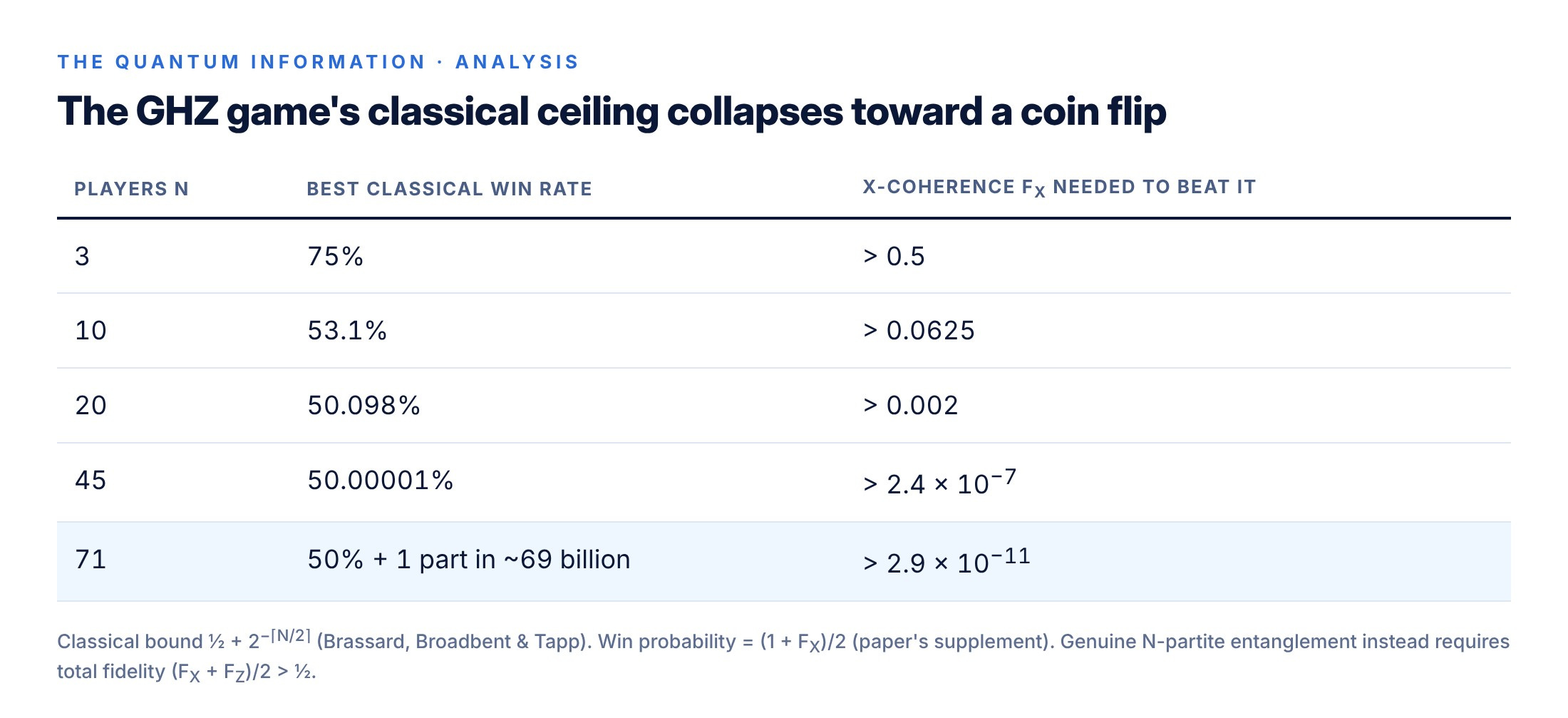
The right-hand column comes from a relation in the paper's supplementary material: the game's win probability equals (1 + F_X)/2, where F_X is the average fidelity of the GHZ state's X-type stabilizers, essentially its surviving "all-zeros plus all-ones" coherence. Setting that equal to the classical ceiling gives the threshold. At 71 players, any coherence that can be distinguished from zero beats the classical strategy.
Our analysis: this explains a detail that otherwise looks odd. The paper certifies genuine multipartite entanglement only up to 45 qubits, yet beats the classical bound up to 71. These are different bars. The entanglement witness requires the total fidelity F = (F_X + F_Z)/2 to exceed ½, a fixed and demanding threshold. The game requires F_X to exceed a number that shrinks exponentially. Above roughly 20 players, "beating the classical limit" in this game becomes the statement "the GHZ coherence is measurably above zero," and the experimental challenge shifts from physics to statistics: enough shots to resolve a small positive margin from 50%. Google's error bars, built from 50 qubit layouts × 20 inputs × 1,000 shots per size, are designed for exactly that.
What matters at large N is therefore not whether the chip beats the bound but by how much, which is a direct readout of F_X. A quick calculation shows how hard that margin is to keep. The supplement quotes a symmetric readout error of about 0.7% per qubit. If those errors are independent, each one flips the parity of the answer with that probability, and the expected parity is multiplied by (1 − 2ε)^N. At N = 71 that factor is 0.986⁷¹ ≈ 0.37. Before counting a single gate error or any decoherence, readout alone caps the 71-player win rate near 68%. The game is a clean, scalable benchmark precisely because every error anywhere in the register shows up in a single bit.
The bound that is a proposal
The hidden linear function problem is where the "advantage" language is strongest, and where the caveats matter most. In 2018 Bravyi, Gosset and König proved that a constant-depth quantum circuit on a 2D grid solves this problem exactly, while classical circuits of bounded fan-in need depth that grows logarithmically with the input size. It was the first unconditional separation of its kind, and its source is the same contextuality that powers the GHZ game.
The proof is asymptotic. The paper itself notes that the rigorous bound becomes relevant only around a million qubits, and that the theorem concerns circuits that succeed with probability 7/8 rather than exact solutions. For hardware-scale instances, the authors propose a classical yardstick instead: an output that depends on all s input bits needs at least log₂(s) layers of two-input gates, with s the number of edges plus nodes in the grid. Against that, they define the quantum cost as an effective depth of 4 CZ layers divided by the fraction of correct bitstrings. At 105 qubits that is about six layers, below the yardstick.
Two points deserve emphasis. First, the comparison is between circuit depths in an idealized model, not wall-clock time. The paper checks every quantum output against a classical simulation in Stim, which handles these 105-qubit Clifford circuits easily. This is a bounded-resource separation, not a claim that a classical computer cannot solve the problem. Second, the bound is a conjecture specific to this regime.
Our analysis: the yardstick also reveals where this kind of noisy demonstration must stop. The classical bound grows like log₂(3N) on a square grid, while the quantum success probability falls roughly exponentially with qubit count at fixed error rates. Taking the reported success at 105 qubits (between about 0.6 and 0.67, depending on whether one reads Google's blog or the preprint's effective depth) and assuming a constant per-qubit error, the quantum effective depth overtakes the conjectured classical bound somewhere around 160 to 220 qubits. Halving the per-qubit error pushes that crossover only to roughly 380 to 510 qubits. This is a crude extrapolation, not a result from the paper, but the structure is robust: without error correction, a logarithmic classical bar is eventually cleared by an exponential noise penalty. Bravyi, Gosset, König and Tomamichel showed in 2020 that a version of the separation persists under noise, for geometrically local circuits in three dimensions, with a construction that borrows from fault-tolerant quantum computation. Some form of error correction is the price of scaling these separations. That is the experiment to wait for.
The hard one
That leaves the smallest experiment, which is the most demanding in physical terms. The magic square's classical ceiling does not move: 8/9 at four qubits, forever. Willow lost about one round in 59. The Bell–Kochen–Specker measurement is stricter still: it requires 540 sequential non-demolition measurements of two-qubit Paulis, read out through an ancilla, and its value is independent of the input state. The published value, χ = 5.590 ± 0.008, sits 7% below the quantum maximum of 6 and well above the non-contextual limit of 4. (The December 2025 preprint reported 5.618 ± 0.005; the published figure is the one to cite.)
There is also a conceptual caveat that the coverage has mostly skipped. In a Bell test, the "no communication" condition is enforced by physics, through spacelike separation. Here, Alice and Bob are neighbouring transmons on one chip, and no-communication is enforced by circuit design: no gates connect their qubits after the Bell pairs are shared. The experiment is a high-fidelity demonstration of contextual correlations, not a loophole-free test of local realism, and the paper does not claim otherwise. Single-device contextuality tests also face a "compatibility loophole," since noisy measurements are only approximately compatible; the supplement includes checks that incompatible measurements decorrelate as expected.
Why the benchmark is the real product
Google's most practical claim is the least headline-friendly one: these tasks caught coherent errors that random-circuit benchmarks missed. That fits how the two methods work. Random circuits scramble the direction of small systematic over-rotations, so they average into something that looks like stochastic noise. Structured Clifford circuits, in which many qubits must agree exactly, let the same rotations add up and show themselves.
The deeper appeal is the ceiling. Most benchmarks ask whether a device beats a classical bar that moves as classical algorithms improve. These tasks are graded against limits set by quantum mechanics itself: χ = 6, a win probability of 1, an effective depth of exactly 4. The gap to that ceiling is an objective, hardware-level score.
What this means in practice
For hardware teams: a GHZ-game win rate as a function of N is a compact way to report a register-wide coherence curve, and the magic square plus χ make a two-qubit sanity check that is hard to game. Both are easy to reproduce on any platform with mid-circuit measurement.
For algorithm researchers: contextuality is linked theoretically to magic states and measurement-based computation. This paper shows it can be measured at many-body scale; it does not show that contextuality is what makes useful algorithms fast.
For readers of advantage claims: ask what kind of bound sits on the other side. An exact bound that shrinks toward 50%, an exact bound that never moves, and a proposed bound in an idealized circuit model are three different kinds of evidence.
What to watch next
The milestone that would change the story is an HLF-style separation run on encoded qubits, where the logical success probability stops decaying with size. Short of that, look for others to adopt the contextuality suite as a cross-platform benchmark, for a sharper finite-size classical bound for the 2D HLF problem, and for the GHZ-game margin at 71 qubits to grow on the next processor generation. The perspective that accompanies the paper in Science, by Rui Soares Barbosa, is a good companion to the original.
Sources
Google Quantum AI and collaborators, "Quantum-classical separation in bounded-resource tasks arising from measurement contextuality," Science 394, 870–874, published 19 November 2026. https://www.science.org/doi/10.1126/science.aec3042
Preprint and supplementary material: S. Kumar et al., arXiv:2512.02284, submitted 1 December 2025. https://arxiv.org/abs/2512.02284
S. Kumar and R. Cortiñas, "A game you cannot win unless you have a quantum computer," Google Research blog, 19 November 2026. https://research.google/blog/a-game-you-cannot-win-unless-you-have-a-quantum-computer/
G. Brassard, A. Broadbent and A. Tapp, "Quantum Pseudo-Telepathy," Foundations of Physics 35, 1877–1907 (2005); arXiv:quant-ph/0407221. https://arxiv.org/abs/quant-ph/0407221
S. Bravyi, D. Gosset and R. König, "Quantum advantage with shallow circuits," Science 362, 308–311 (2018). https://www.science.org/doi/10.1126/science.aar3106
S. Bravyi, D. Gosset, R. König and M. Tomamichel, "Quantum advantage with noisy shallow circuits," Nature Physics 16, 1040–1045 (2020). https://doi.org/10.1038/s41567-020-0948-z
R. Soares Barbosa, "A quantum paradox at work," Science Perspective, 19 November 2026 (linked from the article page above).
Calculations in the "Our analysis" sections are this publication's own, derived from the formulas and parameters published in the paper and its supplement. They are labeled as analysis and are not results reported by the authors.