

Over the past few years, a growing body of work has tried to give mixed quantum states — states that have been hit by noise, decoherence or measurement — the same kind of phase classification that ground states of gapped Hamiltonians enjoy. A central tool in that programme is the Markov length, which has been proposed as the mixed-state counterpart of the energy gap. In a new preprint, David C. Newsom and Michael Levin (University of Chicago) show that this quantity has a surprising weakness: even an arbitrarily weak layer of local noise, applied to the simplest possible state, can make the Markov length jump from zero to infinity.
This article was drafted with Claude and fact-checked against the cited primary sources.
Why this paper is worth your time
The result is short (a 5-page main text plus 21 pages of appendices), explicit and checkable, and it goes straight at a conjectured stability property that several recent definitions of mixed-state phases rely on. If the Markov length is meant to play the role of a gap, one would like it to be stable: a state with a finite Markov length should keep a finite Markov length after a sufficiently weak finite-depth circuit of local channels. The paper shows that this fails in general, already for a pure product state, and then traces out what that means for proposed definitions of “same phase”.
What the paper does
The Markov length is defined through the conditional mutual information (CMI) I(A:C|B) between a region A and a distant region C, given a buffer B in between. A state has Markov length ξ if the CMI is bounded by a polynomial prefactor times e−dist(A,C)/ξ; if no finite ξ works, the Markov length is infinite. Earlier work by Sang and Hsieh showed that if the Markov length stays bounded while a finite-depth channel circuit is applied, that circuit can be undone by another local channel circuit, one gate at a time. Follow-up work showed that states connected in this “locally reversible” way share long-distance properties such as topological degeneracy.
Newsom and Levin ask whether a finite Markov length survives weak local noise, and answer no in general. Their main results, all proved in the paper, are:
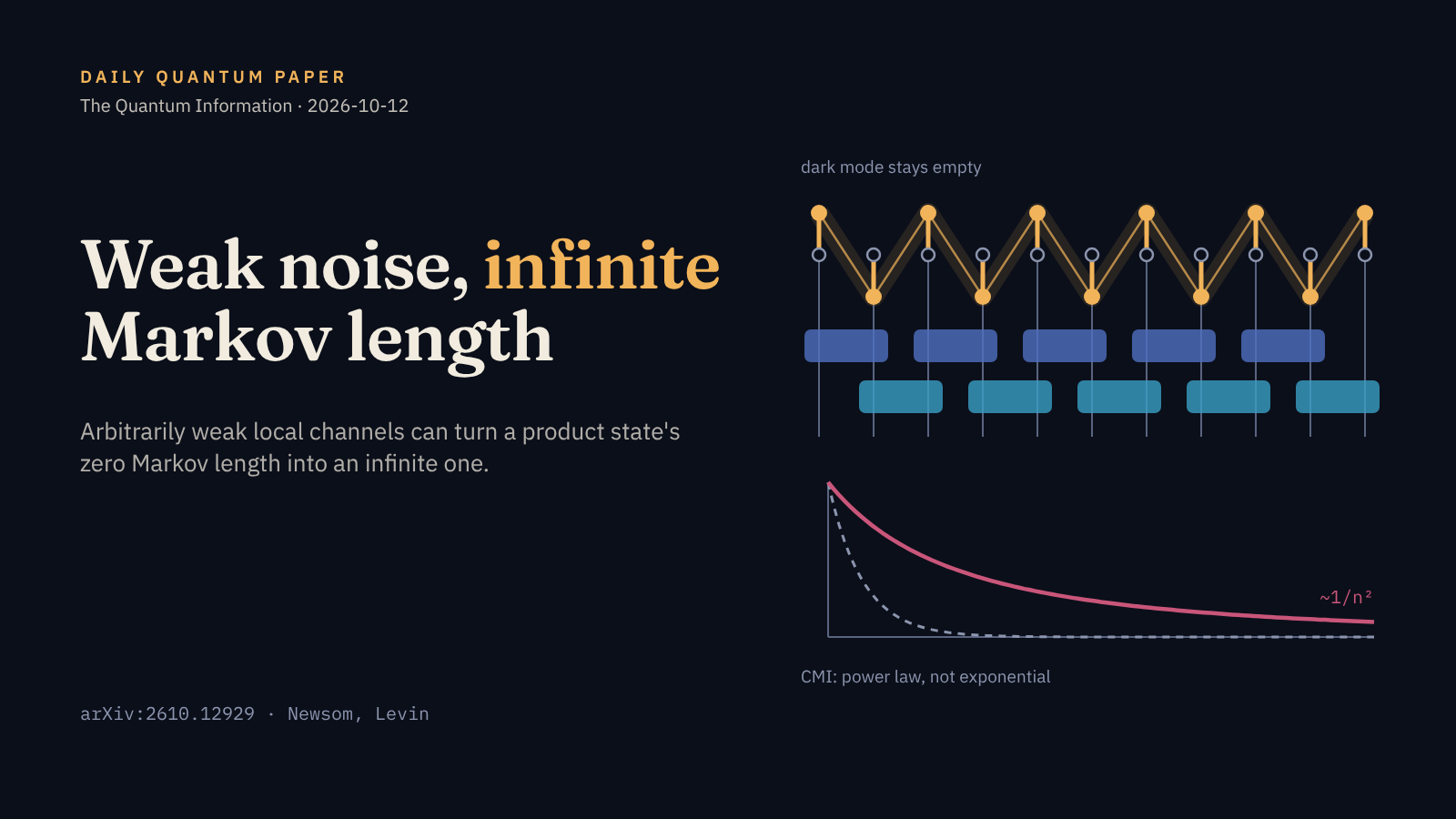
A fermionic counterexample. Starting from the empty (vacuum) state of a one-dimensional chain of spinless fermions, a depth-two brickwork circuit of nearest-neighbour Gaussian channels produces a state whose CMI decays only algebraically with the buffer width — roughly as 1/nB2 for large regions. The Markov length is therefore zero at zero noise strength and infinite for every nonzero strength, no matter how small.
Variants. The same behaviour appears for a time-independent local Lindbladian, for canonical bosons, and on an ordinary qubit chain, where the authors construct a local depth-two qubit channel that becomes arbitrarily weak.
A general statement. The Markov length is unstable for any translation-invariant state with at least one rank-deficient reduced density operator on a finite region. The authors note that this class includes the toric-code ground state.
The key idea: a mode the noise cannot touch
Each two-site channel in the fermionic example works in three steps: bring in a fermionic ancilla in the maximally mixed state, couple it to the symmetric combination of the two neighbouring modes via a Gaussian unitary whose angle ε sets the noise strength, and trace the ancilla out. Because every channel couples only to symmetric combinations of neighbours, the staggered mode cπ = Σj(−1)jcj is orthogonal to all of them. This “dark mode” is never populated, so it stays exactly empty after the circuit.
That single exactly-empty mode is the whole story. In momentum space it shows up as a zero of the lower band of the state’s correlation matrix, which vanishes quadratically, λ−(k) ≈ γk2. The von Neumann entropy of a fermionic Gaussian state is a sum of h(x) = −x log x − (1−x) log(1−x) over correlation-matrix eigenvalues, and h is not analytic at x = 0. Feeding a quadratic zero into this nonanalytic function produces a logarithmic singularity in the second derivative of the entropy density in momentum space.
How it works
The technical route runs through Fourier analysis. For a ring of N unit cells, the entropy is a sum of the momentum-space function g(k) over N evenly spaced momenta. Smooth functions have rapidly decaying Fourier coefficients, but the logarithmic singularity makes g’s coefficients fall off only as 1/|m|3. As a result, the ring entropy picks up a correction proportional to ζ(3)/N2 on top of the usual volume-law term.
For an interval of N unit cells, the authors show (heuristically in the main text, rigorously in an appendix using Toeplitz-matrix methods) that the entropy is a volume-law term, plus a constant from the endpoints, minus c/N2 with c = γζ(3)/2. In the combination of entropies that defines the CMI, the volume and boundary terms cancel exactly, and the 1/N2 terms do not. What remains is a CMI that decays as a power of the buffer width.
Two further observations sharpen the picture:
The effect is fine-tuned. Changing the relative weights of the two sites in each channel, or starting from a finite-temperature product state instead of the vacuum, lifts the zero of λ−. The CMI then decays exponentially again.
Rényi entropies behave differently. For integer Rényi index n ≥ 2, the relevant entropy function is analytic at the endpoints, and the Rényi CMI decays exponentially even in the unstable state. For non-integer n, an algebraic tail reappears with exponent 2n. The n → 1 limit recovers the von Neumann result.
Why it matters
The authors spell out the consequences for two recent definitions of mixed-state phase equivalence: one requiring two-way connection by locally reversible circuits, and one requiring a one-way channel path along which the Markov length stays bounded. Under either definition, the noisy state they construct is not in the same phase as the product state it came from, for any nonzero noise strength. That conflicts with a requirement the authors regard as natural: the trivial phase should itself be stable, so a product state hit by sufficiently weak local noise should stay trivial. If one insists on this, the authors conclude, those definitions are too restrictive.
They also point out that the older definition based only on two-way channel connectivity avoids the problem, but at a cost: it puts the product state and the classical loop state in the same phase, even though the latter supports topological degeneracy and classical topological memory. Their suggested conclusion is that a good notion of mixed-state phase should sit between these extremes — coarser than the Markov-length-based criteria, finer than bare channel connectivity.
Technical perspective (interpretation)
The following is this article’s interpretation, not a claim made in the paper. The mechanism hinges on rank deficiency: an exactly pure “virtual” degree of freedom that weak noise cannot mix. Generic noise models tend to make reduced states full rank, which is why the paper’s examples need tuned channels or initial states. So the result does not suggest that Markov-length diagnostics fail in typical numerical studies of noisy topological codes. Its force is structural. Any definition of a phase that should hold for all weak local channels has to cope with these tuned cases. Pure or rank-deficient states — ground states of frustration-free models, for example — are exactly the starting points people care about.
A second practical point follows from the Rényi analysis. Because integer Rényi CMIs decay exponentially here while the von Neumann CMI does not, a study that diagnoses Markov length through a Rényi-2 proxy could miss this kind of instability entirely. The power-law tail is also slow, ~1/nB2, with a prefactor that vanishes as the noise strength goes to zero. In small-system numerics it could be hard to tell apart from a long but finite Markov length.
Limitations and open questions
Initial states with full-rank reductions. The instability relies on the initial state having a rank-deficient reduced density matrix somewhere. The authors explicitly say they cannot rule out stability for initial states whose reductions are all full rank, such as the maximally mixed state or finite-temperature Gibbs states, and they cite partial stability results in that direction.
Fine-tuning. The explicit examples require tuned channels and initial states. The general theorem is an existence statement: for any qualifying state, some arbitrarily weak circuit produces infinite Markov length. It does not say generic noise does.
Is it intrinsically quantum? The authors leave open whether a classical analogue exists: whether weak local stochastic maps acting on a classical product distribution must always yield exponentially decaying CMI.
What should replace the current definitions? The paper argues for an intermediate notion of phase equivalence but does not propose one.
Paper information
Title: An Instability of the Quantum Markov Length
Authors: David C. Newsom, Michael Levin (Leinweber Institute for Theoretical Physics, University of Chicago)
arXiv: 2610.12929 (v1, submitted 9 October 2026), quant-ph; cross-listed to cond-mat.stat-mech
Length: 5 + 21 pages, 3 figures. This is a theory paper; no code or data accompany it.
Primary sources
D. C. Newsom and M. Levin, “An Instability of the Quantum Markov Length,” arXiv:2610.12929 (HTML full text).
S. Sang and T. H. Hsieh, “Stability of mixed-state quantum phases via finite Markov length,” Phys. Rev. Lett. 134, 070403 (2025), arXiv:2404.07251 — where the Markov length and the stability question were introduced.
S. Sang, L. A. Lessa, R. S. K. Mong, T. Grover, C. Wang, and T. H. Hsieh, “Mixed-state phases from local reversibility,” arXiv:2507.02292 — one of the definitions the paper challenges.