

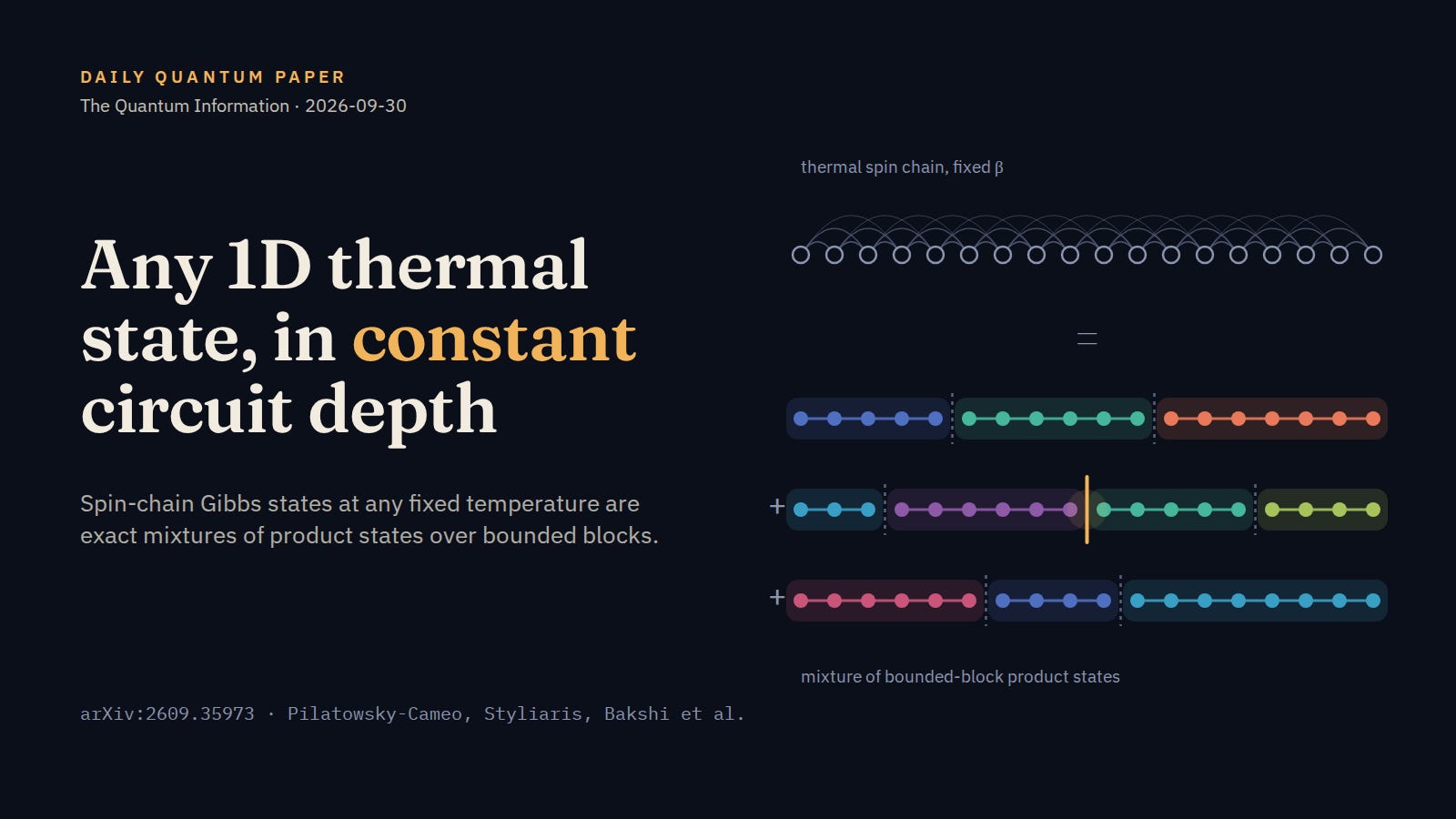
How much genuinely quantum structure survives in a system at thermal equilibrium? For one-dimensional spin chains, a new preprint by Saúl Pilatowsky-Cameo, Georgios Styliaris, Ainesh Bakshi and Daniel Malz gives an unusually clean answer: at any fixed temperature, the Gibbs state of any local spin chain is exactly a classical mixture of states that factorize into blocks of bounded size. The immediate consequence is that such thermal states can be prepared by quantum circuits whose depth does not grow with the length of the chain.
This article was drafted with Claude and fact-checked against the cited primary sources. The paper is a theory preprint (arXiv:2609.35973v1, submitted 28 September 2026) and has not yet been peer reviewed; everything below that goes beyond restating its theorems is labelled as interpretation.
Why this paper is worth reading
Preparing thermal (Gibbs) states is a standard subroutine in quantum simulation, and it is also a way of asking a structural question: how complex can a state at thermal equilibrium be? In one dimension, correlations in Gibbs states were already known to decay exponentially, and recent work had bounded the total bipartite entanglement and shown that entanglement between distant regions vanishes after tracing out the middle. On the algorithmic side, the paper notes that the best provable 1D Gibbs samplers currently guarantee a mixing time linear in system size, and that the best known circuit depth (from an adiabatic algorithm) scales polylogarithmically with the system size. This paper removes the size dependence of the depth entirely, and does so through an exact structural decomposition rather than an approximation.
What the paper proves
The setting is a ring of N qubits with a geometrically local Hamiltonian: a sum of terms, each acting on r adjacent qubits with operator norm at most 1. The main results, as stated by the authors, are:
Block separability (Theorem 1). For any constant inverse temperature β, the Gibbs state is exactly a mixture of product states over partitions of the ring into contiguous blocks. Each block contains at most a constant number Cβ = exp(exp(cr·max(1, β))) of qubits, with cr = exp(16r), and each block state is a matrix product state with bond dimension at most Cβ.
Efficient classical sampling (Theorem 2). A classical algorithm running in time poly(N, 1/ε) samples the blocks and their states, reproducing the Gibbs state to trace-norm error ε.
Constant depth (Corollary 1). The Gibbs state is a mixture of states prepared from |0…0⟩ by nearest-neighbour circuits of depth exp(exp(O(β))), independent of N.
Bounded multipartite entanglement (Corollary 2). Entanglement depth and entanglement width are both bounded by Cβ.
Sudden death of localizable entanglement (Corollary 3). If two regions are farther apart than Cβ, no entanglement can be concentrated between them even with local measurements and classical communication on the sites in between.
Fermions (Theorem 3). Gibbs states of 1D local fermionic Hamiltonians are exact mixtures of fermionic Gaussian states acted on by constant-depth, parity-preserving local fermionic circuits on bounded blocks.
The key idea: cut the chain, but only where it is safe
A Gibbs state is not a product state, so the question is where it can be cut without losing anything. The authors’ answer is that it can always be cut somewhere inside every sufficiently long stretch of chain, with the cut positions themselves being random. Each term of the mixture has its own set of cuts, and summed over all terms the mixture reproduces the exact thermal state. Because no term has entanglement crossing its cuts, each term is a product of states on bounded blocks, and each of those can be prepared in constant depth.
How the proof works
The argument builds on an “entanglement bulk decomposition” from earlier work, which the authors generalise so that any site of a ring can be removed. It writes the unnormalised Gibbs operator as e−βH = M e−βH∖k X, where H∖k drops every interaction touching site k, M is an operator acting on m = exp(O(β)) sites around k (carrying the quantum correlations), and X is a “quasilocal perturbation of the identity” whose terms decay exponentially with their size (carrying only classical correlations).
Applying this at inverse temperature β/2 at sites spaced m apart splits the ring into elementary blocks joined by local operators Mj, surrounding a middle operator built from a staircase of these identity perturbations. Adapting earlier pinning arguments, the authors show that when the decay is fast enough (they take a decay constant of 1/112) the staircase is separable across blocks.
The remaining step is to find cuts that none of the Mj cross. Each block factor is split into a positive piece that already factorises across the block’s midpoint plus a positive remainder that is at most a fraction (1 − η) of the whole. Grouping L consecutive blocks into a “superblock”, every term in the expansion except one contains a factorised piece and hence a cut. The one exception is suppressed by (1 − η)L, and for L = exp(9m) the authors show it can be absorbed while keeping separability. The result is at least one cut per superblock, so each block in the final decomposition has at most 2mL ≤ Cβ qubits.
The sampling algorithm follows the same steps: sample a term of the separable staircase, then sample the cut positions (which form a nearest-neighbour classical distribution on a ring and can be drawn exactly with a forward–backward transfer-matrix sweep in O(N) time), then sample pure states on the resulting blocks.
Why it matters
The paper states three kinds of consequences. For state preparation, Corollary 1 gives circuit depth independent of N using strictly local gates; the authors state that all previous Gibbs-state preparation algorithms in this regime either had depth growing with system size or required quasilocal gates. The decomposition also separates the quantum work (constant-depth circuits) from the classical work (polynomial-time sampling), which the authors note matters in practice because classical computation may be much cheaper.
For entanglement, Corollary 3 strengthens a recent result that distant regions become separable after the middle is traced out: tracing out can hide entanglement that measurements could still localise (a GHZ state is the standard example), and the new result rules that out for 1D Gibbs states beyond a constant distance. The authors contrast this with a recent 2D commuting-Hamiltonian example where long-distance localizable entanglement does survive at finite temperature.
For dynamics, Corollary 4 uses the decomposition, together with prior results, to prove thermalization for translation-invariant chains with nondegenerate spectral gaps: typical states from maximally entropic, low-complexity ensembles at any constant effective temperature become locally indistinguishable from the Gibbs state under unitary evolution, with finite-size fluctuations O(N−1/2+δ) for any δ > 0.
Technical perspective (interpretation)
My reading is that the most durable contribution is conceptual: “thermal states in 1D are short-range entangled” is turned from a heuristic into an exact, constructive statement with explicit block sizes. The constant-depth result should be read in that light. The constants are enormous (doubly exponential in β, with cr itself exponential in the interaction range), so the result says nothing directly about practical circuit depths at low temperature. Its practical value is more likely as a structural guarantee, and possibly as a template: the authors point out that for a specific model the required block size can be estimated numerically, which could give far smaller circuits than the universal bound.
Limitations and open questions
Temperature scaling. The depth bound is doubly exponential in β. The authors ask whether this is optimal, i.e. whether some family of Hamiltonians requires depth matching exp(exp(O(β))).
Exact versus approximate. The decomposition is exact; allowing approximation may improve the β dependence. The authors cite prior work with subexponential-in-β bond dimension, at the cost of quasi-linear scaling in N when compiled into circuits.
Beyond qubit chains. Qudits are expected to follow by a straightforward adaptation (stated, not proved here); bosonic systems with infinite local dimension are left open.
Two dimensions. Whether 2D Gibbs states are similarly mixtures of short-range entangled states is open. A positive answer would rule out finite-temperature topological order in 2D, which is currently proven only for commuting Hamiltonians.
Thermalization assumptions. Corollary 4 requires translation invariance and nondegenerate spectral gaps, and concerns ensembles satisfying specific complexity and maximal-entropy conditions.
Status. This is a v1 preprint with no experiments, numerics or code; the results are mathematical proofs that have not yet been peer reviewed.
Paper information
Title: One-dimensional quantum Gibbs states in constant circuit depth
Authors: Saúl Pilatowsky-Cameo (MIT Center for Theoretical Physics), Georgios Styliaris (Max Planck Institute of Quantum Optics), Ainesh Bakshi (New York University), Daniel Malz (University of Basel)
arXiv: 2609.35973v1 [quant-ph], submitted 28 September 2026; 5 + 13 pages, 1 figure
Code/data: none (theoretical work)
Primary sources
Paper (abstract page): arxiv.org/abs/2609.35973
Full text (HTML): arxiv.org/html/2609.35973v1