

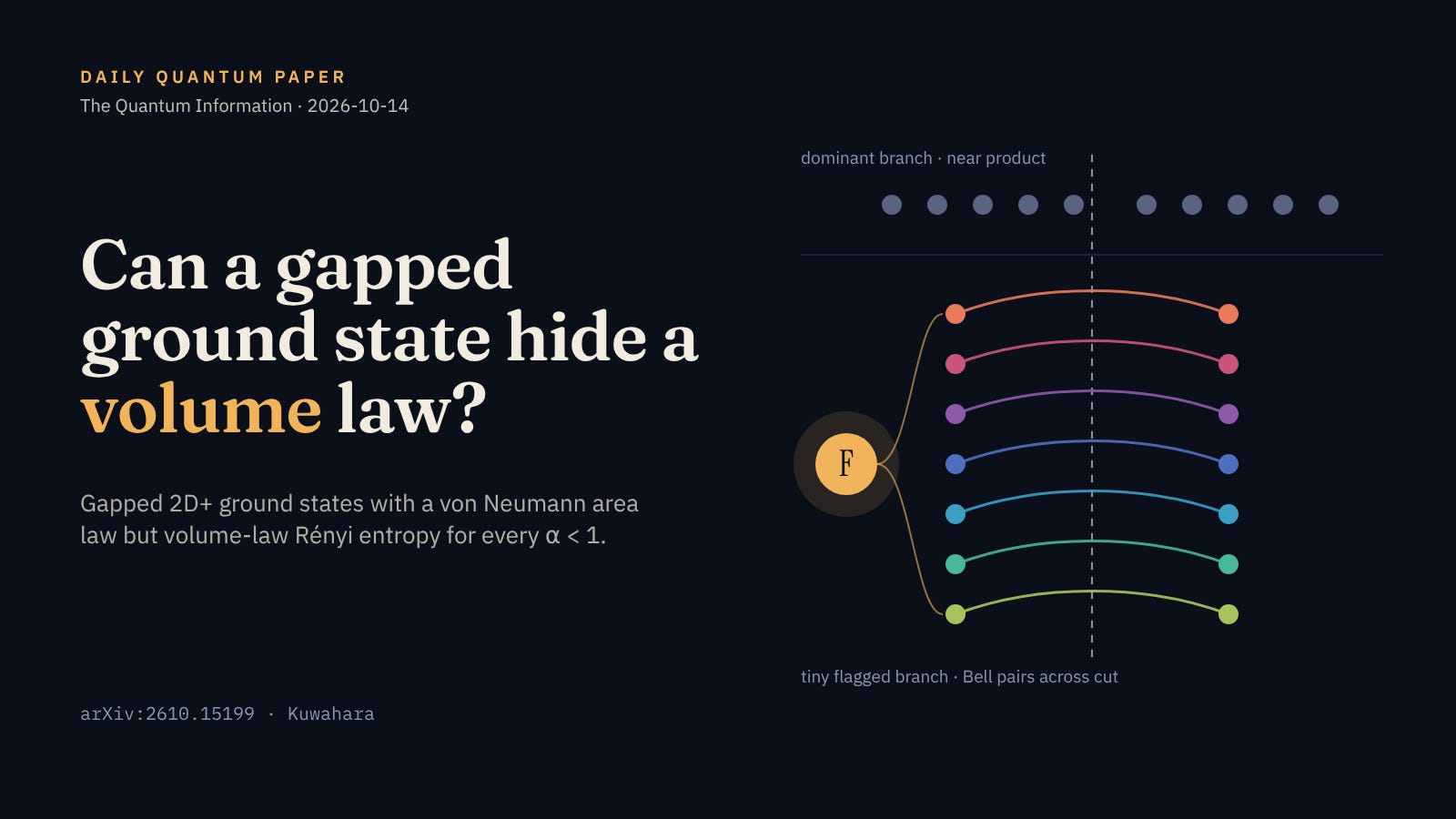
For two decades, one of the most quoted expectations in quantum many-body physics has been the area law: in the ground state of a gapped local Hamiltonian, entanglement between a region and its complement should scale with the region’s boundary, not its volume. In one dimension this is a theorem, and it holds for every Rényi entropy. In two and higher dimensions it is still largely open. A new paper by Tomotaka Kuwahara (RIKEN) settles one well-defined piece of that question, and the answer is negative: for every Rényi index α strictly between 0 and 1, the higher-dimensional Rényi area law is false.
This article was drafted with Claude and fact-checked against the cited primary sources. All statements about the results are taken from the paper (arXiv:2610.15199v1); passages marked as interpretation are mine.
What the paper does
The Rényi area-law conjecture, as stated in the paper, asks whether every uniformly gapped local lattice Hamiltonian satisfies, for each fixed 0 < α < 1, a bound of the form “α-Rényi entropy ≤ Cα × (size of the cut’s cross-section)”, with a constant independent of system size. The paper proves three results:
Result 1 (upper bound). For any finite-range Hamiltonian in any fixed dimension with a unique ground state and a spectral gap — no frustration-freeness or local-gap assumption — there is an approximate ground-state projector (AGSP) across a planar cut whose log operator Schmidt rank scales as roughly 𝒜 + (𝒜 · log 1/ε)2/3, up to logarithmic factors and a gap-dependent factor, where 𝒜 is the cut’s cross-section and ε the target accuracy.
Result 2 (optimality). In the high-accuracy regime (log 1/ε at least of order 𝒜), explicit uniformly gapped Hamiltonian families require log Schmidt rank at least c(𝒜 · log 1/ε)2/3, both to approximate the ground state and for any AGSP. So the 2/3 exponent is optimal at fixed gap, up to logs. In one dimension this improves the earlier 3/4 exponent for general (frustrated) systems to 2/3 and shows it cannot be improved.
Result 3 (the counterexample). For every fixed 0 < α < 1 and every dimension ν ≥ 2, there are finite-range Hamiltonians with fixed local dimension, a uniform spectral gap and unique ground states whose α-Rényi entropy across the cut is at least cα·n — a volume law.
The key idea: complexity hidden in a tiny branch
The paper calls its mechanism error-space complexity. Write a state as a dominant component plus a small-amplitude component ε|φ⟩. If that small component can be singled out by a projector that is a product across the cut — fixed in advance by the construction, for example a “flag” qubit sitting on one side — then the Schmidt tail of the full state is at least the branch probability times the Schmidt tail of the extracted component. A branch of tiny probability that contains many Bell pairs across the cut therefore forces a long Schmidt tail on the whole ground state.
The von Neumann entropy barely notices such a branch. Rényi entropies with α < 1, however, weight small Schmidt coefficients more heavily, and the paper shows this is enough to produce a volume law for them while the von Neumann entropy still obeys an area law across the same cuts.
How the construction works
The lower-bound Hamiltonians are built from parallel Feynman–Kitaev-type history states. In outline, according to the paper:
Each row runs a local “clock” based on an adjacent-exchange graph; a random-deletion flow argument bounds the relevant Poincaré constant by O(m3), with both a product source and a target containing m Bell pairs keeping constant stationary mass. This is realized with six local states and positive semidefinite local rewrite terms.
Rather than stacking independent clocks, the rows share a single attractive “root” well and are activated in sequence by a local prefix track; the paper proves that the full-system spectral gap stays bounded below independently of system size.
A fixed product projection then extracts a component equal (up to local isometries) to M·m Bell pairs across the cut, with weight at least exp[−C(M + M·m3/2)], where M is the cross-section size and m sets the row length.
Higher dimensions are reached by a cut-preserving serpentine re-embedding. The precise theorem gives local dimension at most 6, interactions of at most 5 sites and range at most 2. In 2D a suitable rectangular aspect ratio is chosen for each fixed α; in three and higher dimensions a single hypercubic family works for every α < 1.
Two further properties make the counterexample sharp. The ground states have a product state with overlap at least 1/2, and they can be connected to product states along uniformly gapped local paths — so they sit in the same gapped phase as a product state. And the von Neumann entropy obeys an area law across the same cuts.
Why it matters
The result separates two notions that are often used interchangeably. Low-index Rényi entropies (α < 1) and the von Neumann entropy capture different aspects of gapped ground states: according to the paper, neither criticality nor a phase transition is needed for a Rényi volume law. At the same time, the paper notes that a Rényi volume law does not by itself prevent accurate low-rank approximation across a given cut when the von Neumann entropy is area-law.
The optimality result also addresses proof technique. AGSP arguments drove the one-dimensional area law, and in higher dimensions they would need a square-root-type rank–error trade-off. The paper shows that in the worst case, using locality and a gap alone, the best possible exponent is 2/3, so optimizing the conventional AGSP condition cannot by itself establish a general higher-dimensional area law. A side result for one-dimensional Gibbs states shows that, for Rényi entanglement of purification with α of order β−1/3, no universal inverse-temperature exponent smaller than 2/3 is possible.
Technical perspective (interpretation)
My reading is that the paper turns a known intuition — small Schmidt weights can make Rényi entropies with α < 1 large without harming MPS-style approximability (Schuch, Wolf, Verstraete and Cirac made this point in 2008) — into a statement about uniformly gapped ground states on genuine lattices. The essential new ingredient is engineering such a tail while keeping a size-independent physical gap and product-state connectivity. The “note added” in the paper is also worth flagging: it cites a recently released proposed proof of a two-dimensional von Neumann area law under a global gap assumption. If that proof holds, α = 1 would be exactly the threshold for a universal Rényi area law in 2D gapped systems; the paper states that its own results do not depend on it.
The paper also contains an explicit acknowledgment of AI assistance: the author reports extensive use of ChatGPT models, and says that the lower-bound construction giving the optimal scaling originated from a proposal by a model called GPT-6 Astra, then was developed and rigorously analysed with the author, who takes full responsibility for the statements and proofs.
Limitations and open questions
The counterexample is worst-case and engineered (history-state Hamiltonians); it says nothing about whether typical physical models violate Rényi area laws.
The rank lower bounds hold only in the high-accuracy regime; a matching lower bound at all accuracies is open.
The optimal dependence of the AGSP upper bound on the spectral gap is unknown; optimality is claimed only at fixed gap.
The lower-bound families have system size chosen according to the target accuracy, and the upper bound concerns a single prescribed cut, not an efficient global tensor-network construction.
The paper leaves open whether adaptive, state-dependent AGSP schemes could still give efficient ground-state approximation.
This is a v1 preprint with a 25-page appendix of proofs; it has not yet been peer reviewed.
Paper information
Title: The Rényi area law conjecture is false below α=1 in high dimensions
Author: Tomotaka Kuwahara (Analytical Quantum Complexity RIKEN Hakubi Research Team, RIKEN Center for Quantum Computing; RIKEN Pioneering Research Institute)
arXiv: 2610.15199v1 [quant-ph], submitted 10 October 2026; 7 pages + 25 pages appendix, 6 figures
Code/data: none (theoretical work)
Primary sources
T. Kuwahara, “The Rényi area law conjecture is false below α=1 in high dimensions,” arXiv:2610.15199 (HTML full text, PDF)
I. Arad, A. Kitaev, Z. Landau, U. Vazirani, “An area law and sub-exponential algorithm for 1D systems,” arXiv:1301.1162 — the earlier AGSP rank–error bounds the new paper improves on.