

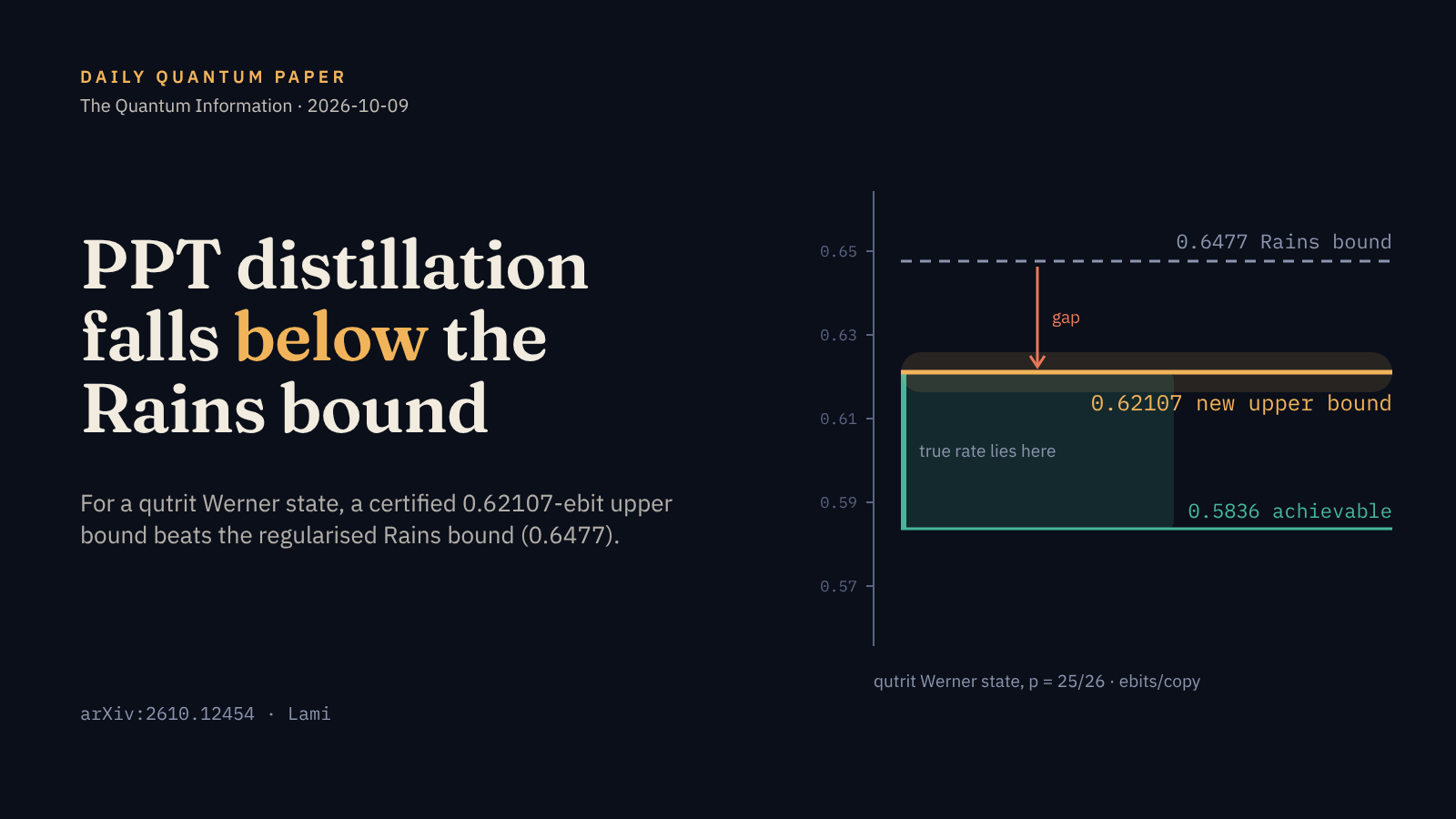
Entanglement distillation asks a deceptively simple question: given many copies of a noisy entangled state, how many near-perfect Bell pairs (ebits) can you extract per copy? For most mixed states nobody knows the answer, even if we relax the rules and allow the larger class of PPT operations instead of local operations and classical communication (LOCC). For PPT distillation, one natural candidate answer had been on the table for years: the regularised Rains bound. A new preprint by Ludovico Lami shows that this candidate is wrong, and gives a certified counterexample using a two-qutrit Werner state.
This article was drafted with Claude and fact-checked against the cited primary sources. One more disclosure belongs up front, because the paper makes it itself: in a note at the start of the introduction, the author states that the main results and techniques “have been derived almost entirely by ChatGPT Astra”, with the human author extending the initial findings and spending many hours validating and improving the proofs.
What the paper does
The paper studies PPT entanglement distillation in the standard quantum Shannon theory regime: the error must vanish asymptotically but may be non-zero for any finite number of copies. PPT channels are those that remain completely positive when conjugated by the partial transpose; they contain every LOCC protocol, so the PPT distillable entanglement Ed,PPT upper-bounds the LOCC distillable entanglement. The author lists three main contributions:
A regularised formula (Theorem 1) expressing Ed,PPT exactly as the regularisation of a measurement-based, relative-entropy-like quantity.
Two new converse bounds (Theorems 2 and 3): one built from quadratic forms on operator spaces, the other from Hirschman’s strengthening of the Hadamard three-line theorem. Both give exponential strong converses.
A strict separation (Theorem 4): for the 3×3 Werner state with antisymmetric weight p = 25/26, the PPT distillable entanglement is at most 0.62107 ebits, while the regularised Rains bound equals (25/26) log25 − log23 ≈ 0.64766 ebits.
The last result answers in the negative the conjecture, stated explicitly in Regula et al. (New J. Phys. 21, 103017, 2019), that Ed,PPT always equals the regularised Rains bound.
The key idea
The Rains bound measures how far, in relative entropy, a state is from operators σ whose partial transpose has trace norm at most one. Its regularised version R∞ was the tightest known upper bound on PPT distillation and, by a previous result cited in the paper, it is computable. If Ed,PPT had equalled R∞, PPT distillation would have been “solved” in a strong sense.
The paper’s strategy is to look at a distillation protocol through the only test that matters at the end: the overlap of the output with a maximally entangled state. For PPT channels this overlap reduces to a semidefinite constraint on a test operator Q (0 ≤ Q ≤ 1, with the operator norm of its partial transpose bounded by 1/d). Pulling this test back to the input gives both directions of the new formula: the achievability side uses a fixed measurement plus classical typicality, and the converse side uses the two-outcome measurement obtained from the protocol’s Bell test.
How it works
The formula. Theorem 1 defines L(ρ) as a supremum over POVMs {Ej} of a sum of terms Tr[ρEj] log(Tr[ρEj] / ‖EjΓ‖∞), and proves Ed,PPT(ρ) = limn L(ρ⊗n)/n. Restricting to projective measurements recovers an older bound of Rains. Because any finite POVM gives a valid lower bound, this yields an increasing sequence of computable lower bounds; the author is careful to note that this lower semicomputability was already obtainable by other means and that no convergence speed is known.
A quantitative negativity bound. As a by-product, the paper proves Ed,PPT(ρ) ≥ 1 − h2(1/2 + N(ρ)/(d+1)), where N is the negativity, h2 the binary entropy and d the smaller local dimension. This turns the known qualitative fact (Eggeling et al., 2001) that every state with a non-positive partial transpose is PPT-distillable into an explicit positive rate.
Two converses. The quadratic-form converse EQ controls how a distillation test interacts with a chosen positive super-operator, with an optional ancillary extension; choosing right multiplication recovers the Rains bound, and other choices can beat it. The analytic converse EA embeds the input in an analytic family of operators on an annulus and averages two trace-norm bounds over its two boundary circles with Hirschman’s weights; quantum hypothesis testing then transfers the bound back to the actual state.
The Werner certificate. Werner symmetry shrinks everything to small, checkable problems. On the upper-bound side, a two-dimensional quadratic-form calculation already gives a value of about 0.63309, below R∞; an explicit annulus family, with its boundary integral bounded using directed rounding, gives 0.62107. On the lower-bound side, an exactly feasible 48-copy, 49-outcome POVM certifies 0.5836 ebits. So for this state the true PPT rate lies in roughly [0.5836, 0.6211], strictly below 0.6477.
Why it matters
Demonstrated in the paper: the regularised Rains bound is not the PPT distillable entanglement, already for a highly symmetric two-qutrit state. Since every LOCC protocol is PPT, the new converses also join the list of upper bounds on LOCC distillation, which the paper summarises as Ed,LOCC ≤ min{R∞, Esq, EQ, EA}, with Esq the squashed entanglement.
The author also notes a consequence for computability: had Ed,PPT equalled R∞, known algorithms for R∞ would have made it Turing-computable. The separation removes that route without ruling out computability by other means.
Technical perspective (interpretation)
This is my reading, not a claim made in the paper. The result fits a pattern seen across quantum resource theories: the “obvious” relative-entropy-style monotone, regularised, is often not the operational answer once errors are only required to vanish asymptotically. What stands out here is how concrete the counterexample is. The gap between 0.62107 and 0.64766 is small, about 0.027 ebits, but it is certified with rational witnesses and interval arithmetic rather than inferred from floating-point optimisation.
The authorship note is also worth taking seriously on its own terms. The paper is explicit that an AI system produced most of the mathematics and that the human author validated it. That makes independent checking of the certificates, which the paper says run with only the Python standard library, especially valuable.
Limitations and open questions
No closed formula yet. Theorem 1 is a regularised expression; there is no single-letter formula and no guarantee on how fast the lower bounds converge.
The Werner gap remains open. For p = 25/26 the rate is pinned only to the interval [0.5836, 0.6211]; Figure 1 shows a visible gap between achievable and converse curves across the whole range of non-PPT Werner states.
Computability is still undecided. The paper states that a convergent computable family of upper bounds remains open.
PPT, not LOCC. The separation concerns PPT distillation. It improves upper bounds on LOCC distillation but does not compute the LOCC rate.
Verification status. This is a v1 preprint and has not been peer reviewed. The text describes a companion certificate supplement (README, manifest of SHA-256 hashes, and a verification script), but the v1 abstract page lists no ancillary files and the PDF gives no download link for it. The v1 text also has some rough edges, such as a duplicated figure caption with inconsistent equation references.
Paper information
Title: On PPT entanglement distillation
Author: Ludovico Lami (Scuola Normale Superiore, Pisa)
arXiv: 2610.12454v1 [quant-ph], submitted 8 October 2026
Length: 31 + 7 pages, 1 figure
Code/data: a computational certificate supplement is described in Appendix F; no public link in v1
Primary sources
Paper (abstract page): arxiv.org/abs/2610.12454
Full text (PDF): arxiv.org/pdf/2610.12454v1
Conjecture addressed: B. Regula et al., New J. Phys. 21, 103017 (2019)
Background: E. M. Rains, “A semidefinite program for distillable entanglement”, IEEE Trans. Inf. Theory 47, 2921 (2001)