

Suppose Alice is handed the description of any qudit state and Bob the description of any measurement. In the quantum world, Alice simply prepares the state and sends a single d-dimensional system to Bob, who measures it. How much classical communication would they need to reproduce exactly the same outcome statistics, if they are allowed unlimited shared randomness? A new preprint by Riccardo Castellano, Pavel Sekatski and Nicolas Brunner (University of Geneva) gives an answer that is both reassuring and sobering: a finite number of bits suffices on average, but only in a precise and rather weak sense.
This article was drafted with Claude and fact-checked against the cited primary sources. It is worth reading because it closes most of a question that goes back to the Toner–Bacon result of 2003 and that was sharpened only weeks ago by a no-go theorem from de Gois, Santos and Vieira.
What the paper does
The setting is the one-way prepare-and-measure scenario. A classical simulation consists of shared randomness λ, an encoder that maps Alice’s pure state ψ to a message from an alphabet of size lλ, and a decoder with which Bob samples an outcome given his measurement, λ and the message. The simulation must reproduce the Born-rule probabilities exactly, for every state and every POVM.
The authors separate three ways of counting communication: the worst-case alphabet size, the expected alphabet size E[lλ], and the expected number of bits E[log lλ]. Their two main results pull these apart:
No-go (Theorem 1). For d ≥ 4, every exact one-way classical simulation of qudit correlations has infinite expected alphabet size. This strengthens the recent result of de Gois, Santos and Vieira (arXiv:2609.04182), who showed that the worst-case alphabet size must be infinite for d ≥ 4. The proof follows their original argument and assumes measurability of the encoder and decoder, an assumption the authors say can likely be removed.
Exact simulation (Theorem 2). For every d ≥ 2 there is an exact one-way simulation of all states and all POVMs whose expected communication is finite: E[log lλ] ≤ log d + nd(⌈log(4dnd)⌉ + 2), with nd = 2d − 2, i.e. O(d log d) bits. The probability of using more than k bits decays exponentially in k.
Together, these say that a qudit cannot be faked with a finite average message dimension, yet can be faked with a finite average number of bits. That is the sense of the title’s claim that the cost is “as high as it could be”.
The key idea
The construction rests on a general simulation theorem that is not specific to quantum theory. Alice’s possible inputs form a set X and Bob’s task is described by a family of maps assigning each input a probability distribution. The authors define the mass deficit of a subset R of inputs: how much probability mass, in the worst case over Bob’s maps, is not shared by all inputs in R. A subset is “small” when every input in it produces nearly the same output distribution, whatever Bob measures.
From this they build a covering dimension, the “mass-deficit Minkowski dimension”, modelled on box-counting dimension. The general result (Theorem 3) is that whenever this dimension is finite, an exact one-way simulation with finite expected communication exists, again with an exponential tail on message length.
How it works
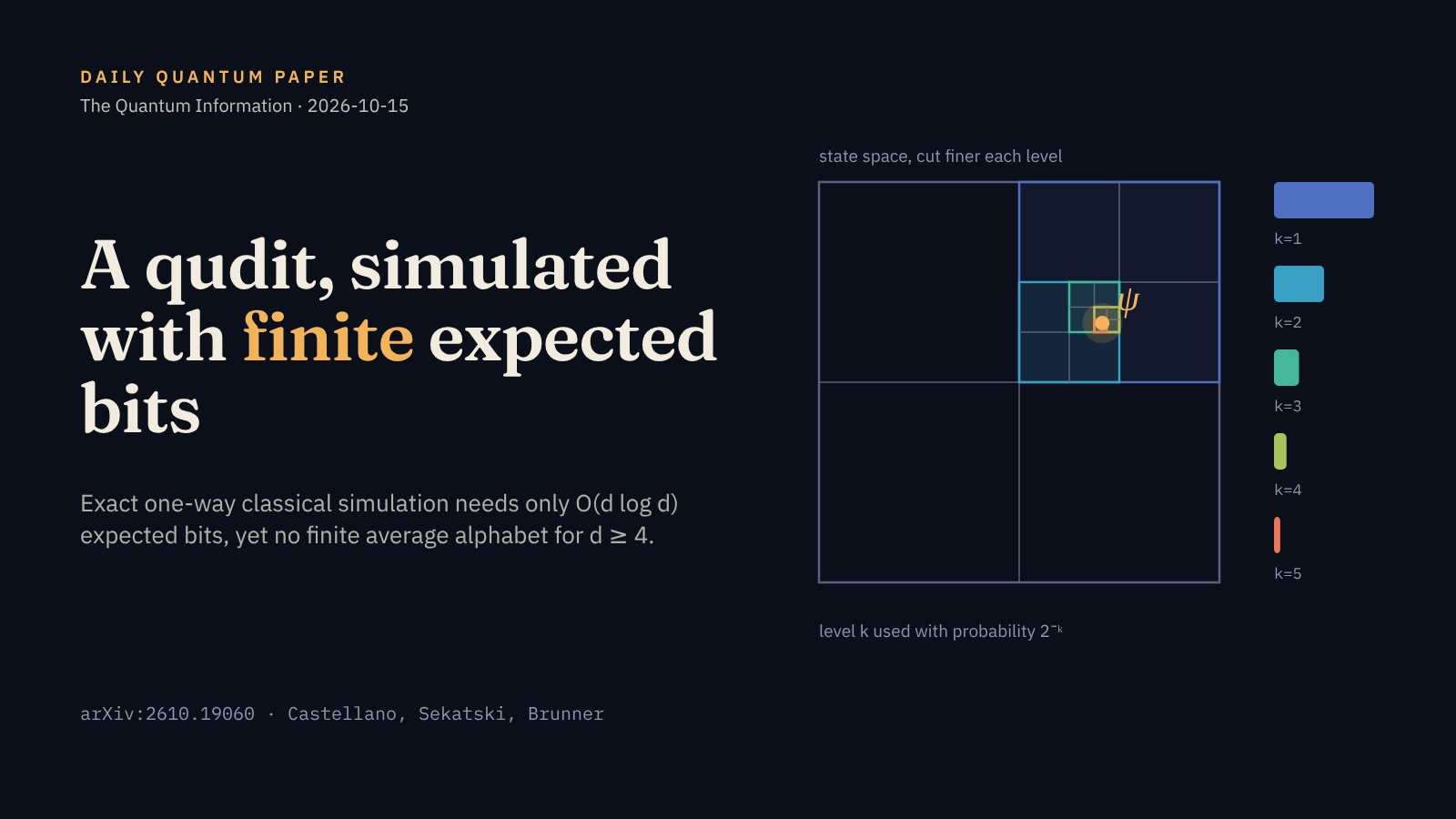
Alice and Bob agree in advance on a nested sequence of partitions of the state space, each one refining the previous. The shared randomness picks a level k with probability 2⁻ᵏ. Alice sends only the label of the cell at that level that contains her state; she does not need to send k, because it is shared.
Bob’s decoder is built recursively. At each level he knows a lower envelope: the probability mass that every state in the received cell is guaranteed to put on each outcome. The recursion assigns a cumulative sub-distribution of total mass 1 − 2⁻ᵏ that is safe for every state in the cell, and reserves the remaining mass for finer levels. Averaged over k, the contributions telescope and reproduce the Born probabilities exactly; the error after k levels is exactly 2⁻ᵏ in L1 norm before the limit is taken.
For qudits, the authors use a lemma bounding the mass deficit of a cell by d times its trace-distance diameter, and an explicit nested partition of pure-state space (real dimension 2d − 2) whose cells shrink geometrically. Since the expected level is 2 and the label length grows linearly in the level, the expected number of bits is finite. The expected alphabet size, however, diverges in their construction for every d ≥ 2, and Theorem 1 shows this is unavoidable for d ≥ 4.
Beyond qudits
Because the theorem only needs finite mass-deficit dimension, it also covers generalized probabilistic theories with finite-dimensional state spaces and some infinite-dimensional quantum systems. The paper works out the example of n-mode Gaussian states with mean photon number at most E, measured by arbitrary general-dyne measurements (which include heterodyne and, as a limit, homodyne detection). There, the expected number of bits grows logarithmically in E; for one mode the bound is 10 log E + O(1). The energy bound is essential: without it, the channel would have infinite classical capacity.
The paper also gives an approximate protocol with a fixed, finite alphabet and no shared randomness, accurate in Kullback–Leibler divergence, and notes consequences for the Bell scenario: by having Alice sample her outcome locally and then simulate Bob’s conditional state, correlations of entangled d × d states can be simulated with finite average one-way communication.
Why it matters
Communication-cost questions are one of the cleanest ways to quantify how “non-classical” quantum resources are. Earlier results gave lower bounds, showing that alphabet size must grow at least exponentially in d, and a growing list of exact models for small cases: one bit for projective measurements on a Bell state (Toner and Bacon), and a finite worst-case alphabet for qubits and qutrits. This paper pins down where the boundary lies for every finite d: finite in expected bits, infinite in expected alphabet size (for d ≥ 4). Notably, the simulation respects the causal structure of the scenario by using only one-way communication, unlike earlier two-way models.
Technical perspective (interpretation)
My reading is that the most reusable contribution is the general theorem, not the qudit bound. It turns an operational question into a geometric one: if the “operationally induced” size of state-space cells shrinks polynomially fast, exact simulation with finite expected bits follows almost automatically. The proof is short, and the necessity remark in the paper (the cumulative decoder must stay below the lower envelope) suggests the mass deficit is the right notion of size for this nested-encoding strategy.
It is also worth being clear about what “finite on average” buys. The scheme sometimes sends very long messages; they are just exponentially rare. The gap between expected bits and expected alphabet size is exactly the gap between the averages of log l and of l, which can differ dramatically under heavy-tailed distributions.
Limitations and open questions
The O(d log d) expected-bit bound is an upper bound; the authors do not claim it is optimal. They frame the optimal tail exponent of the message-length distribution as open, with bounds 1/(2d − 2) ≤ β* ≤ 1 for d ≥ 4.
Theorem 1 relies on measurability assumptions on encoder and decoder; the authors expect these can be removed but do not prove it here.
Whether Haar-random rotation of the partition improves the approximate protocol’s asymptotic accuracy is left open.
For bounded-energy Gaussian systems, it is open whether a model with finite expected alphabet size exists.
Extensions to three or more parties, and to other continuous-variable classes, are proposed but not worked out.
This is a v1 preprint and has not yet been peer reviewed. The results are theoretical; there is no experiment or code.
Paper information
Title: The cost of classically simulating quantum communication is as high as it could be
Authors: Riccardo Castellano, Pavel Sekatski, Nicolas Brunner (Department of Applied Physics, University of Geneva)
arXiv: 2610.19060v1 [quant-ph], submitted 13 October 2026
Length: 11 pages of main text, 11 pages of appendix, 1 figure
Primary sources
Castellano, Sekatski, Brunner, arXiv:2610.19060 (HTML full text)
de Gois, Santos, Vieira, “Quantum communication and Bell nonlocality require infinite classical communication to simulate”, arXiv:2609.04182
Toner, Bacon, “Communication cost of simulating Bell correlations”, Phys. Rev. Lett. 91, 187904 (2003), quant-ph/0304076