

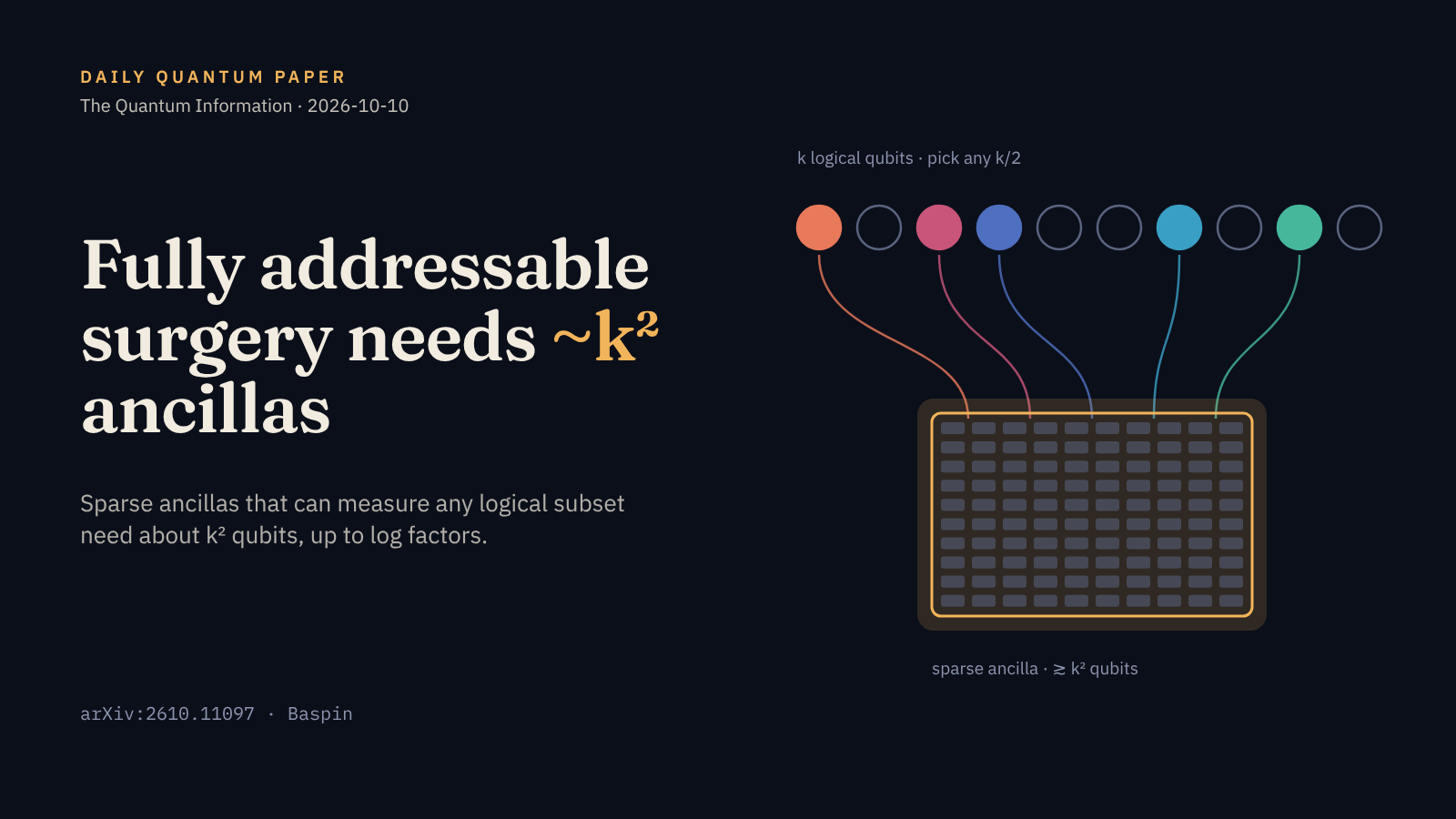
Quantum LDPC codes promise to store many logical qubits in comparatively few physical ones. But storing information is only half of fault tolerance: a computer also has to measure chosen logical operators, and lattice surgery has become a leading way to do that. A short new paper by Nouédyn Baspin asks a blunt question about the price of flexibility: if you want to be able to measure any choice of logical operators on a sparse code, how large must your surgery ancilla be? The answer is a lower bound that grows quadratically with the number of logical qubits.
This article was drafted with Claude and fact-checked against the cited primary sources.
What the paper does
The paper, “A lower bound on the overhead of surgery on sparse stabiliser codes” (arXiv:2610.11097v1, submitted 8 October 2026), proves a no-go theorem. For a stabiliser code on n physical qubits with k logical qubits, any family of surgery ancillas that is sparse, and that can realise every measurement in a sufficiently rich set, must contain ancillas of size at least Ω̃(k2) in the worst case. The abstract summarises the consequence: for codes with large k, constant-overhead ancillas can only realise a small fraction of the possible measurements.
The paper is theoretical and short: two main results (Lemma 2 and Theorem 3) and two auxiliary counting lemmas. There are no simulations, experiments or code.
The key idea: addressability costs information
The central observation is a counting argument. Suppose a surgery scheme can measure every logical subspace in some set ℱ. Each measurement is carried out by attaching an ancilla complex and a “gluing” map to the code. If the ancilla has at most N⋆ qubits-and-checks and all of its maps are sparse, then there simply are not many distinct sparse ancillas of that size. Since different measurements need different ancilla–map pairs, a large ℱ forces a large N⋆.
Lemma 2 makes this quantitative: N⋆ ≥ Ω(log|ℱ| / (ω log n)), where ω bounds the row and column weights of the relevant maps. In words, the space cost scales with the logarithm of the number of measurements you want access to. The author calls this property addressability: the ability to prescribe exactly which logical degrees of freedom are read out.
How the argument works
Framework. The code is written as a “symplectic complex” and surgery with a CSS ancilla is expressed as a symplectic embedding, following a framework the paper cites as yuan2026noncss. In this language, the ancilla together with its chain map determines which logical subspace is measured (Definition 1).
Counting sparse matrices. Lemma 4 shows there are at most (1+s)ωt ω-sparse binary matrices of size s × t. Applying this to the ancilla’s boundary map and to the map gluing it to the code, and summing over the possible ancilla dimensions, bounds the number of distinct ancilla constructions by an expression of the form (1+N⋆)2((1+N⋆)(1+2n))ωN⋆.
Counting measurements. Theorem 3 fixes a basis splitting the logical operators into X-type and Z-type, and considers only the measurements of k/2-dimensional subspaces of the X-type logicals. These automatically commute, so all are valid. A standard bound (Lemma 5, cited as koetter2007coding) says there are at least 2r(l−r) subspaces of dimension r in a space of dimension l; with r = k/2 and l = k this gives at least 2k2/4 measurements.
Result. Combining the two counts gives N⋆ ≥ Ω(k2 / (ω log n)).
Why it matters
The paper compares its bound with a known construction of parallel surgery (cited as cowtan2025parallel), which can measure any set of t commuting logicals on an n-qubit QLDPC code with at most Õ(tn) ancilla qubits. For constant-rate codes, where k grows proportionally to n, taking t ∝ n gives Ω̃(n2) ≤ N⋆ ≤ Õ(n2). In that regime the upper bound is almost tight: fully addressable parallel surgery cannot be done with much less space than existing constructions use, as long as everything stays sparse.
The author also notes that the bound “seems to point towards” a space–time trade-off: to save space, a scheme must restrict how many different logicals can be measured in each surgery step, which in turn means more rounds of surgery. And it comments on a recent near-linear-overhead construction (cited as cowtan2026nearoptimal) that relies on suitable subcodes: by Theorem 3, such subcodes are in limited supply for codes with many logical qubits, so that approach does not generically give addressability.
The timing is notable. The same quant-ph listing also included “2 Fast 2 Surgery: Fast surgery on QLDPC codes with Õ(n(k + d)) space overhead” (arXiv:2610.11079). We have not reviewed that paper here, but its title alone shows how actively the space cost of surgery on QLDPC codes is being pushed down from above, which makes a lower bound from below especially useful.
Technical perspective (our interpretation)
The argument is information-theoretic rather than structural. It does not identify which measurements are expensive; it shows that a sparse ancilla of size N⋆ can only “encode” roughly ωN⋆ log n bits of choice, while selecting an arbitrary k/2-dimensional logical subspace needs on the order of k2 bits. Put differently, a fully addressable surgery gadget has to be big enough to describe the measurement it performs.
This framing suggests where the bound bites and where it does not. Architectures that only ever need a small, fixed menu of logical measurements, or that compile computations into many rounds with limited parallelism, are not ruled out from having small ancillas. The bound targets the attractive but demanding goal of arbitrary, fully parallel logical measurements on high-rate codes. For architecture designers this reframes a design choice: rate, addressability and ancilla space cannot all be maximised at once under sparsity.
Limitations and open questions
Model assumptions. The theorem applies to surgery in the paper’s symplectic-embedding formalism with a CSS ancilla, where both the ancilla’s boundary map and the gluing map are ω-sparse. Schemes outside this model, or with non-sparse ancillas, are not covered.
Worst case, up to logs. The bound concerns the largest ancilla needed across a set of measurements and hides factors of ω and log n. It does not say that typical or most-used measurements are expensive.
Space only. The result constrains ancilla size, not time. The suggested space–time trade-off is described by the author as an indication, not a proved statement.
Tightness. Near-tightness is shown for constant-rate codes against the cited Õ(tn) construction. For other rate regimes the gap between upper and lower bounds is not settled in this paper.
Status. This is a v1 preprint and has not been peer reviewed.
Paper information
Title: A lower bound on the overhead of surgery on sparse stabiliser codes
Author: Nouédyn Baspin (Iceberg Quantum, Sydney, Australia)
arXiv: 2610.11097v1 [quant-ph], submitted 8 October 2026
Code/data: none (theoretical paper)
Primary sources
Paper (abstract page): arxiv.org/abs/2610.11097
Full text (HTML): arxiv.org/html/2610.11097v1
Same-day related listing: arXiv:2610.11079 (2 Fast 2 Surgery)