

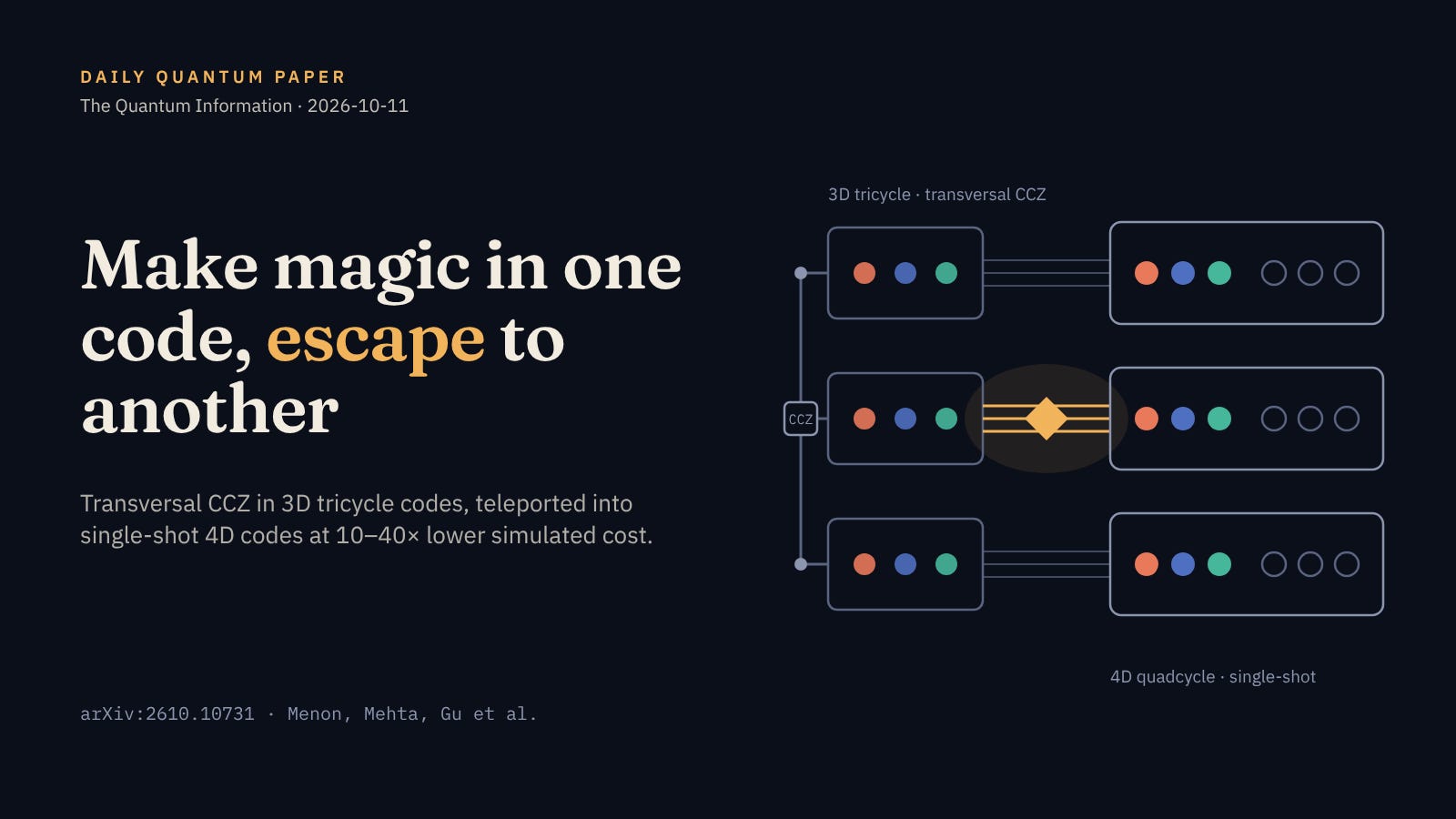
Most proposals for large fault-tolerant quantum computers spend the bulk of their hardware on one job: making magic states, the resource that turns cheap Clifford operations into a universal gate set. High-rate quantum LDPC (qLDPC) codes promise to store many logical qubits in far fewer physical qubits than the surface code, but they have lacked a native, high-throughput magic-state source that keeps their rate advantage. A new preprint from a Harvard–QuEra–Caltech–MIT collaboration proposes a complete factory built from qLDPC codes, and reports, in circuit-level simulations, CCZ magic states at roughly an order of magnitude lower space-time cost than magic state cultivation.
This article was drafted with Claude and fact-checked against the cited primary sources. In the interest of transparency: the paper’s acknowledgements state that the work was supported in part by Anthropic’s AI for Science program and that the authors used Claude models to assist with code search and simulation development.
What the paper does
In “Single-shot magic state factories for quantum LDPC codes” (arXiv:2610.10731), Varun Menon, Rohan Mehta and colleagues design an end-to-end protocol that produces encoded CCZ magic states directly inside high-rate qLDPC code blocks. The construction pairs two families of codes, each doing the job it is good at:
Tricycle codes (three-dimensional balanced-product codes from recent work) support a transversal, constant-depth CCZ circuit, so they can generate several logical magic states in parallel. Their weakness is strongly asymmetric distances: in the pairs studied, each block encodes 3 logical qubits with a Z distance much smaller than its X distance, for example [[27,3,(6,3)]] or [[81,3,(15,5)]].
Quadcycle codes, four-dimensional balanced-product codes found with an AI-assisted search, lack transversal non-Clifford gates but have larger, balanced distances (equal X and Z distance) and single-shot state preparation and error correction in both Pauli bases.
The magic is made in the tricycle code and then teleported, or in the authors’ word “escaped”, into the quadcycle code, where it can be stored and used.
The key idea: a depth-1 escape between related codes
A quadcycle code is defined by four commuting circulant matrices A, B, C, D over a finite abelian group; the first three are exactly the matrices that define its paired tricycle code, and D adds a fourth cyclic direction. The authors show that this shared algebra embeds every tricycle code into its quadcycle partner (formally, the quadcycle complex is a mapping cone of the tricycle complex). The practical consequence is a homomorphic CNOT between the two blocks that is a single transversal layer of physical CNOTs, and that couples all tricycle logical qubits to one half of the quadcycle’s logical qubits. All pairs used in the paper have twice as many quadcycle logical qubits as tricycle ones (k = 6 versus k = 3), which the authors prove is the maximum possible.
How the factory works
Generate. Three tricycle blocks are prepared in |+⟩. A “fan-out” gadget, effectively concatenation with a distance-2 repetition code, turns the code’s depth-2 CCZ circuit into a strictly depth-1 transversal CCZ, which the authors show preserves the circuit-level distance. The result is a nine-qubit logical hypergraph magic state they call |det⟩, implementing the determinant of a 3×3 binary matrix.
Escape. In parallel, three quadcycle blocks are prepared in |0⟩ with a single round of X-stabilizer extraction, possible because these codes are single-shot. The depth-1 homomorphic CNOT then teleports the logical state across.
Postselect. The tricycle blocks are measured transversally in the X basis. Any run with a nontrivial detector is rejected; accepted runs receive Pauli-frame corrections. Because the measured tricycle blocks are small and short-lived, rejecting on every detector remains affordable, and it roughly doubles the number of faults needed for an undetected logical error. The fitted error exponents, 3.11 ± 0.04 for the tricycle-distance-3 factory and 3.91 ± 0.07 for distance 4, match the code distance rather than half of it.
Use. Measuring one logical qubit of each quadcycle block converts |det⟩ into two disjoint CCZ states (the optimal yield), possibly dressed by CZ gates that are fixed using further transversal resource states. The paper also sketches injection by qLDPC code surgery.
What the simulations show
All results are numerical, under the standard circuit-level depolarizing model at physical error rate p = 10−3, with the physical CCZ gates assigned a noise channel of strength p or 2p, and decoding by a most-likely-error decoder. In the abstract, the authors report logical error rates as low as 10−9 per output logical qubit after postselection.
The headline comparison (the paper’s Table 1) is against magic state cultivation, using cultivation numbers estimated with mid-circuit postselection at matched CCZ-converted error rates. Expected space-time volume per CCZ state:
At error rate 1.2×10⁻⁵ (fault distance 3): 4.3×10³ for this work, versus 80.4×10³ for surface-code cultivation and 162.8×10³ for color-code cultivation.
At 1.2×10⁻⁶: 8.6×10³ versus 83.8×10³ for surface-code cultivation.
At 1.6×10⁻⁸: 6.7×10⁴ versus 228.6×10⁴ for color-code cultivation.
These ratios are the source of the “10–40 times” figure. The authors also show that quadcycle codes such as [[72,6,8]] and [[162,6,14]] work as single-shot memories, with per-cycle logical error rates at p = 10−3 comparable to or below the error rate of the states the factory delivers, using a three-round sliding decoding window.
Finally, they compile the whole factory for reconfigurable neutral-atom arrays: every polynomial term becomes a uniform cyclic translation of atoms with acousto-optic deflectors, the transversal CCZ needs a single Rydberg pulse thanks to the fan-out gadget, and the full factory is bounded by 33 array-traversal times for the codes considered.
Why it matters
Recent qLDPC architecture proposals mostly solved storage and Clifford logic; non-Clifford gates were often delegated to surface-code machinery or left open. This work offers a qLDPC-native answer whose output is already encoded in a high-rate block, and whose depth does not grow with code distance because both code families are single-shot in the bases that matter.
Technical perspective (interpretation)
The conceptual move worth noticing is the division of labour: one code with transversal non-Clifford gates but poor distance, chained by a single transversal layer to a structurally related code with good distance and single-shot decoding. It resembles a dimension-jump code switch, but here the receiving code is chosen so that no growth, repetition or second distillation round is needed. My reading is that the approach is less a single code construction than a template, and its value will depend on whether matched code pairs with higher rates keep the same clean properties. The authors note that higher-rate tricycle codes exist but produce harder-to-use hypergraph states and deeper CCZ circuits.
Limitations and open questions
Simulation only. No hardware demonstration is reported; all numbers come from circuit-level simulations.
Accounting boundaries. Table 1 excludes the cost of extracting the two CCZ states and of injection for this work, the T-to-CCZ conversion for cultivation, and decoder latency for every scheme. Cultivation numbers are estimated from other studies, normalized by assuming four T states per CCZ.
Noise modelling. Only one of the three tricycle–quadcycle pairs is simulated; the CCZ channel is reduced to its single-qubit marginal, and full-factory acceptance is taken as the cube of a single pair’s acceptance. The authors argue this is conservative, but it is an approximation.
Decoder. The most-likely-error decoder is too slow for real-time use at scale; the authors point to machine-learning and hierarchical decoders as possible practical substitutes.
Distances. Quadcycle distances are exact only up to n = 72; larger ones are estimates.
Full-algorithm cost. How the savings translate into total qubit count and runtime for algorithms such as Shor’s is left to future work.
Paper information
Title: Single-shot magic state factories for quantum LDPC codes
Authors: Varun Menon, Rohan Mehta, Andi Gu, Andrei C. Diaconu, Daniel Bochen Tan, Xiao Xiao, Michael J. Gullans, Qian Xu, Hengyun Zhou, Mikhail D. Lukin, J. Pablo Bonilla Ataides
Affiliations: Harvard University; QuEra Computing; Joint Center for Quantum Information and Computer Science, University of Maryland; Caltech (IQIM and Walter Burke Institute); MIT
arXiv: 2610.10731v1 [quant-ph], submitted 7 October 2026
Code and data: no code repository is linked; an atom-movement animation is provided as an ancillary file on arXiv.
Primary sources
arXiv abstract page: arxiv.org/abs/2610.10731
Full text (HTML): arxiv.org/html/2610.10731v1