

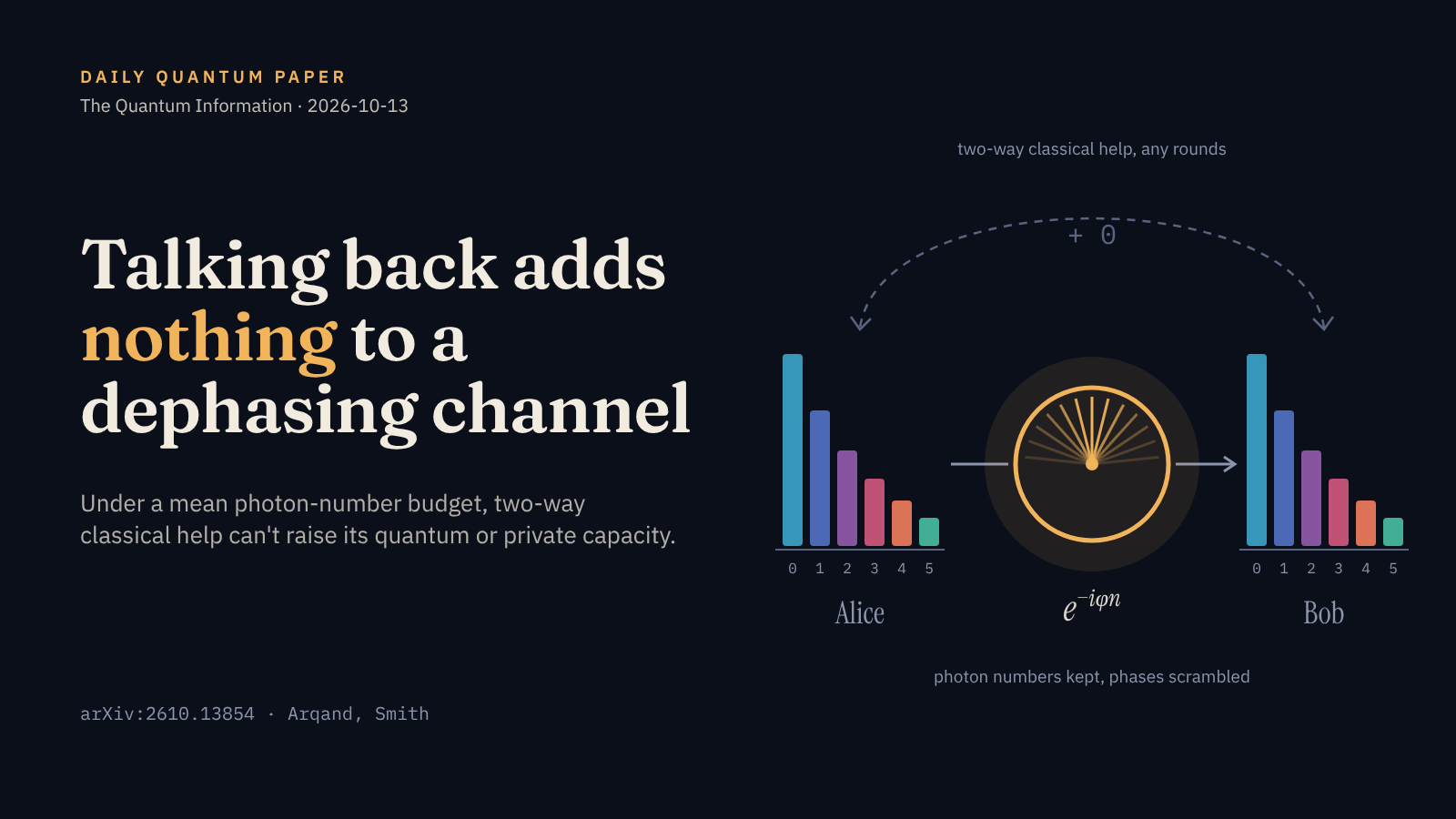
Some quantum channels become more useful when the sender and receiver are allowed to talk to each other over an ordinary classical line. The textbook example is photon loss: a pure-loss channel that lets through half the light or less cannot carry quantum information on its own, yet with two-way classical communication between uses it can distribute entanglement at a positive rate for any nonzero transmissivity. So it is a fair question whether the same kind of help pays off for the other major noise process in optical and microwave modes, dephasing. A new paper by Amir Arqand and Graeme Smith (University of Waterloo) answers it for bosonic dephasing channels with a fixed energy budget: it does not.
This article was drafted with Claude and fact-checked against the cited primary sources.
What the paper does
The paper, “No advantage from classical assistance for energy-constrained bosonic dephasing channels” (arXiv:2610.13854v1), studies single-mode bosonic dephasing channels. Such a channel applies a random phase rotation e−iφn̂ to the mode, with the angle φ drawn from some probability density on [−π, π]. It leaves the photon-number distribution untouched and only damps the coherences between different Fock states.
The authors consider four capacities under an average photon-number constraint E: the unassisted quantum capacity, the unassisted private capacity, the quantum capacity assisted by two-way classical communication (LOCC), and the private (secret-key) capacity assisted by two-way public classical communication. Their main theorem states that, for every phase-noise density and every finite E ≥ 0, all four are equal. The common value is a single-letter formula: the coherent information, maximised over photon-number distributions whose mean is at most E (with the input taken diagonal in the Fock basis).
The assistance allowed is fully general. The parties may keep quantum memories, exchange classical messages between every channel use, and choose later inputs based on earlier outcomes. The energy constraint is imposed on the mean photon number averaged over all uses, so an adaptive protocol may spend more energy in some rounds and less in others.
Where this sits
Lami and Wilde had previously solved the quantum and private capacities of bosonic dephasing channels without an energy constraint (Nature Photonics, 2023), and showed that in that setting the assisted and unassisted capacities coincide. As Arqand and Smith point out, that achievability argument uses inputs spread uniformly over more and more Fock levels, so the mean photon number grows without bound. The unconstrained result therefore did not settle what happens at a fixed input energy, which is the physically natural constraint for bosonic communication. For a Gaussian phase-noise model, earlier work had obtained upper and lower bounds on the energy-constrained LOCC-assisted quantum capacity. The new paper closes this gap for all phase-noise distributions.
The key idea
The unassisted part is the easy half. Bosonic dephasing channels are degradable, and an existing energy-constrained coding theorem for degradable channels (Wilde and Qi) already gives the unassisted quantum and private capacities as a coherent-information optimisation. The authors show the optimum can be taken over Fock-diagonal inputs. Since an unassisted code is also a valid assisted protocol, the assisted capacities are at least this large.
The real work is the converse: proving that no adaptive LOCC protocol can beat that rate. The central trick is to compare the dephasing channel with the completely dephasing channel Δ, which measures the photon number and keeps only the diagonal. Two facts make this comparison clean. First, dephasing in the Fock basis after the channel gives exactly Δ, so the channel output and the fully dephased output are linked by a pinching. Second, Δ cannot create entanglement: it maps PPT-type and separable states to states of the same kind.
How the proof works
A relative-entropy bound. For any input correlated with a reference system and with mean photon number at most E, the relative entropy between the channel output and the completely dephased output is at most the coherent information of the input’s photon-number distribution, with equality for pure inputs (Lemma 3.1).
A chain rule. Combining that bound with a pinching identity for relative entropy gives an energy-constrained chain rule (Theorem 3.1): passing a state through the channel can increase its relative entropy to a dephased comparison state by at most that coherent information.
Entanglement measures. Applied with PPT-type and separable comparison states, the chain rule bounds how much the Rains relative entropy (Theorem 3.2) and the relative entropy of entanglement (Theorem 3.4) can grow in one channel use, even when the input is entangled with the parties’ memories.
Iterating over the protocol. LOCC steps cannot increase either measure. Summing the per-use increments, then using concavity of coherent information and the average energy constraint, bounds the entanglement of the final state by n times the unassisted capacity. Standard arguments then turn this into upper bounds on the assisted quantum capacity (Theorem 3.3) and the secret-key capacity (Theorem 3.5).
The authors also show that both chain rules are tight: they are attained by the canonical purification of any finite-energy Fock-diagonal input (Corollary 3.1). The analysis allows countably supported photon-number distributions and infinite-dimensional local memories and private-state shields, with the infinite-dimensional technicalities handled explicitly.
Why it matters
What the paper proves is a capacity statement: for energy-constrained bosonic dephasing channels, two-way classical communication does not raise the ultimate rate of quantum communication or key distribution. In practical terms, if the dominant noise on a link is pure phase noise and the input power is bounded, the best achievable rate is already captured by one-way coding, and the benchmark for any repeaterless protocol over such a link is the unassisted capacity. This contrasts with the pure-loss channel, where assistance changes the picture qualitatively.
The result also adds to a recent line of work on energy-constrained two-way capacities. The paper cites Pirandola’s result that, for the quantum-limited amplifier, the energy-constrained two-way capacities coincide with the unassisted ones, and a recent analysis of the pure-loss channel by Falco, Mele, Lami and Giovannetti.
Technical perspective (interpretation)
The following is my reading rather than a claim made in the paper. The proof works because the dephasing channel has a simple “classical skeleton”: photon number passes through perfectly, and all the noise lives in the phases. Measuring the output photon number turns any output into a state with no more entanglement than before, and the cost of skipping that measurement is exactly a coherent-information term. This is a structural reason why feedback cannot help: there is no erasure-like failure event that the parties could learn about and work around, which is what makes feedback useful for loss. It also suggests the technique is tied to channels that commute with photon-number dephasing, and would need new ideas for channels that change the photon number.
Limitations and open questions
Scope of the result. It covers single-mode, pure bosonic dephasing channels with an average photon-number constraint. It says nothing directly about channels combining loss and dephasing, which the authors list as a natural next target.
The formula still needs optimising. The capacity is expressed as an optimisation over photon-number distributions. The paper does not identify optimal distributions or give numerical capacity curves for specific phase-noise models; the authors flag this as open.
Asymptotic statements. These are capacities, defined in the limit of many channel uses and vanishing error. Finite-blocklength rates, and whether assistance helps there, are not addressed.
Purely theoretical. There is no experiment, simulation or code; the contribution is a set of proofs. The result is a preprint (v1) and has not yet been peer reviewed.
AI assistance. The authors state that an AI system was used extensively as a research and writing assistant, including help developing the main solution and completing proofs, and that they reviewed and verified all AI-assisted content.
Paper information
Title: No advantage from classical assistance for energy-constrained bosonic dephasing channels
Authors: Amir Arqand and Graeme Smith (Institute for Quantum Computing, University of Waterloo)
arXiv: 2610.13854 (v1, submitted 9 October 2026), quant-ph
Code/data: none (theoretical paper)
Primary sources
A. Arqand and G. Smith, arXiv:2610.13854 (HTML full text)
L. Lami and M. Wilde, “Exact solution for the quantum and private capacities of bosonic dephasing channels,” Nature Photonics 17, 525–530 (2023)
N. Davis, M. Shirokov and M. Wilde, “Energy-constrained two-way assisted private and quantum capacities of quantum channels,” Phys. Rev. A 97, 062310 (2018)
A. Falco, F. Mele, L. Lami and V. Giovannetti, “Energy-constrained two-way capacities of the pure-loss channel,” arXiv:2610.12365